
Thermal Mass Flow Meter for Low Gas Flows: Air, CO2 and Biogas
A thermal mass flow meter is a natural fit for low gas flows because of how it works: it measures the heat a gas stream carries away, which gives mass flow directly, stays sensitive at low velocity and needs no separate pressure or temperature compensation. Typical jobs at a treatment plant include air to individual aeration drop legs, carbon dioxide fed for pH control, and biogas from digesters. Before you buy one, pin down three things: what the gas is, whether it carries water, and how big the pipe is. This article is for process, instrument and design engineers. Blower control from dissolved oxygen is a separate subject, covered in aeration basin DO control.
How a thermal gas flow meter works
A typical thermal mass flow meter uses thermal dispersion. The sensor carries two platinum RTDs. One reads gas temperature; the other is heated and held a fixed temperature difference above it. Flowing gas removes heat from the heated element, and more flow means more heating power is needed to hold the difference. The transmitter converts that power into mass flow.
Because the result is mass flow, or volume at standard conditions, line pressure and temperature swings affect it far less than they affect volumetric meters. The heat signal remains clear at low velocities, which gives a thermal mass flow meter good low-end sensitivity and a wide turndown where orifice plates and vortex meters typically struggle.
Low flow gas measurement jobs that suit thermal meters
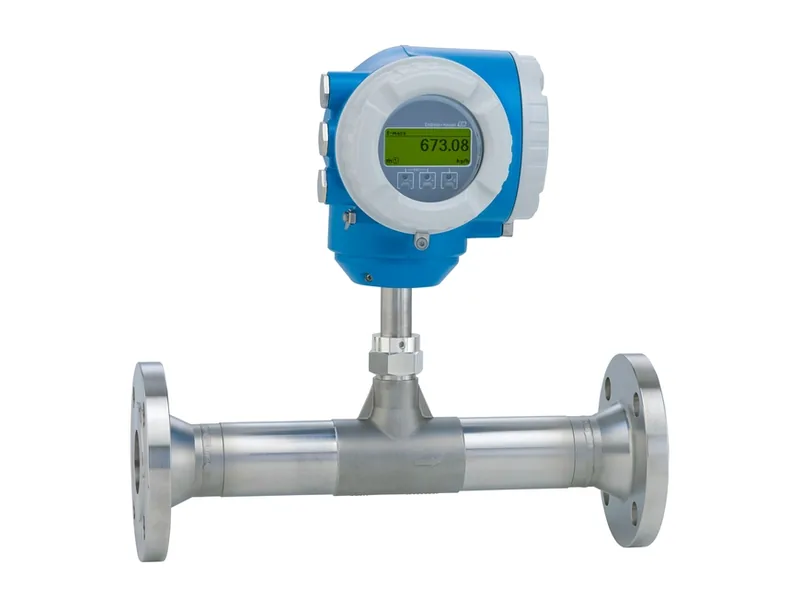
Figure 1: Endress+Hauser Proline t-mass F 300 inline version. Image source: Endress+Hauser official website
- Aeration drop legs. A basin may split air into several low-pressure branches; a meter on each shows whether air is distributed evenly.
- CO2 for pH control. Feed rates are small and must be steady, and mass flow maps directly onto dose. See online pH control dosing for the control side.
- Biogas. Digester and anaerobic reactor gas runs at low pressure and low velocity, a common thermal application.
- Compressed air and nitrogen. Sub-metering of plant utilities and leak hunting.
Chlorine is a different case. It is toxic, and wet chlorine is highly corrosive, so water plants normally meter it with a dedicated chlorinator; the comparison with hypochlorite is in liquid chlorine vs sodium hypochlorite dosing. If a thermal mass flow meter is proposed for chlorine, the manufacturer must confirm materials and conditions first.
Gas composition and moisture
A thermal mass flow meter relies on the gas's thermal conductivity and heat capacity, and these differ from gas to gas. A meter set up for air will read wrong on CO2 or biogas, so configure or calibrate it for the real gas. Biogas is harder still because the methane and CO2 split drifts. Set the meter for typical composition and accept some added uncertainty when composition swings.
Moisture causes more trouble than composition. A water droplet hitting the heated element strips heat instantly and the reading spikes. Biogas and aeration air can both carry condensate. Keep the meter away from low points, fit a condensate drain or separator upstream, insulate the line, and avoid positions where condensate runs along the pipe floor past the sensor.
Insertion or inline?
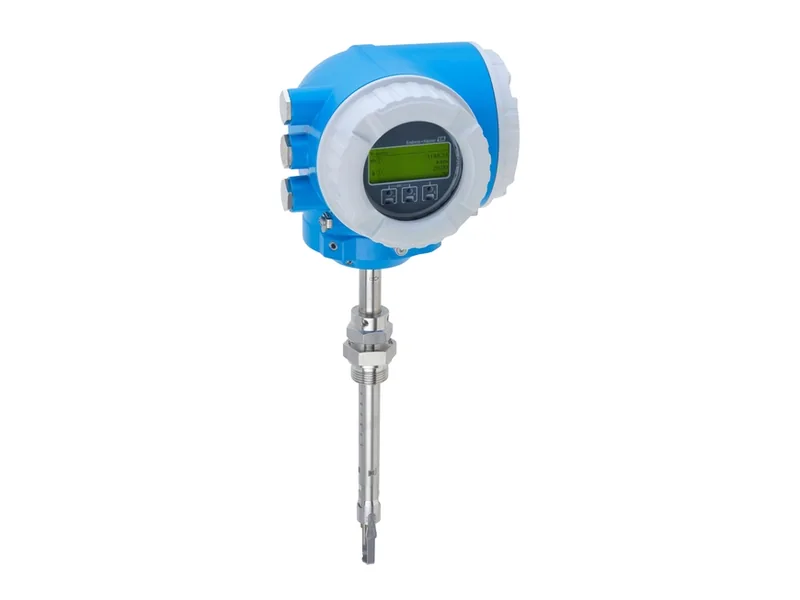
An insertion thermal flow meter pushes a probe into the pipe or duct. It suits large sizes, installs at lower cost, and the advantage grows with diameter. It measures velocity at one point and scales it to the cross-section, so insertion depth, flow profile and straight run matter a great deal.
An inline thermal mass flow meter brings its own measuring tube with flanges or threads and is calibrated as a unit at the factory. It suits small pipes and holds accuracy better at very low flow, but becomes uneconomic on large lines.
As an example, Endress+Hauser lists the Proline t-mass I 300 as an insertion meter for round pipes or rectangular ducts from DN80 to 1500, and the t-mass F 300 as an inline meter from DN15 to 100. Both can be programmed from 21 standard gases or mixtures of them, detect reverse flow, and cover medium temperatures from –40 to +180 °C. Related models are listed under flow meters.
Installation and straight run
A thermal mass flow meter is sensitive to flow profile, insertion models most of all. Give the meter a generous upstream straight run away from elbows, valves, tees and blower outlets, and consider a flow conditioner where space is short. Align an insertion probe with the flow and set depth exactly as the manual says. A probe that is rotated or at the wrong depth produces a consistent bias.
On aeration drop legs, the classic mistake is a throttling valve right in front of the meter with almost no straight pipe, and the reading jumps all over the place. Either move the thermal mass flow meter or reserve straight run for it at design stage.
Maintenance
Dust or oil on the sensor forms an insulating layer and the thermal mass flow meter drifts low over time. With oily compressed air, or biogas carrying sulfides and particles, pull and clean the sensor on a schedule. Hydrogen sulfide in biogas is corrosive, so confirm sensor materials with the manufacturer. Before removing an insertion probe, make sure the line is depressurized or isolated by a valve. In biogas and CO2 areas, ventilate and use gas detection to guard against poisoning and asphyxiation.
Conclusion
A thermal mass flow meter measures mass flow directly through thermal dispersion and stays sensitive at low velocity, which makes it a good choice for aeration drop legs, CO2 feed and biogas. Success depends on configuring the real gas, keeping condensate off the sensor, providing straight run, and choosing insertion or inline by pipe size. Send us the gas, pipe size, pressure, temperature and moisture conditions, and contact our engineers to confirm the thermal mass flow meter model and mounting.
FAQ
Can a thermal mass flow meter measure liquids?
No. Thermal gas flow meters are designed and calibrated around gas heat-transfer properties. For liquids, look at magnetic, ultrasonic or Coriolis meters.
Can a meter set up for air measure nitrogen?
Nitrogen behaves much like air in a thermal mass flow meter, but reconfiguring for nitrogen is still recommended. Gases that differ a lot, such as CO2 or biogas, must be set up for the actual gas.
Why does the reading suddenly jump high?
Usually a droplet of water has hit the sensor. Check for low-point water, condensate drains and insulation, and move the meter if needed.
Do I have to shut off the gas to fit an insertion probe?
It depends on the fitting. Designs with an isolation ball valve can sometimes be installed or removed under pressure following the manufacturer's procedure; without a valve, depressurize first.
Can it read flow in both directions?
Some models measure bidirectionally or flag reverse flow, so state it when ordering. Biogas headers and ducts shared by parallel blowers can see backflow.