
Desalination Chemical Dosing: SWRO Pretreatment to Remineralization
Desalination chemical dosing falls into two stages. Before the membranes, pretreatment dosing (biocide, coagulant, pH adjustment, a reducing agent and antiscalant) protects the reverse osmosis elements. After the membranes, post-treatment remineralization with carbon dioxide, lime or caustic, followed by disinfection, makes the permeate safe to send into a distribution network without attacking pipes. Seawater is rich in chloride, so in desalination chemical dosing every pump head, valve and pipe that touches it must be specified for seawater corrosion. This article walks through the whole SWRO train for design consultants, plant operators and dosing system integrators. Single-chemical details are covered in separate articles linked below.
Where the dosing points sit in an SWRO plant
Following a seawater reverse osmosis plant from intake to product water, the usual desalination chemical dosing points are:

Figure 1: ProMinent Sigma/ X S1Cb motor-driven diaphragm pump. Image source: ProMinent official website
- Intake or intake line: biocide against marine growth and microorganisms.
- Ahead of media filters or ultrafiltration: coagulant to flocculate colloids and fine solids.
- Ahead of the cartridge filters: a reducing agent to remove residual oxidant, antiscalant to protect the membrane surface, and acid where pH correction is needed.
- After the RO: carbon dioxide, lime or caustic for remineralization, then disinfectant.
Each point uses a different chemical, strength and control method, so desalination chemical dosing is normally built as several independent pump sets, one per point.
Pretreatment desalination chemical dosing: biocide and coagulant
Seawater carries algae, larvae and a heavy microbial load. Without disinfection, intake lines and pretreatment equipment grow biofilm quickly. Sodium hypochlorite is the usual choice, dosed continuously or as periodic shock treatment depending on water quality and season. Some plants generate it on site by electrolysis of seawater; others buy it in.
Coagulant, typically a ferric salt, goes in ahead of the filtration step with a static mixer or mixing tank so floc forms before the filters. Seawater temperature and turbidity swing with the seasons, so coagulant rates need adjusting, ideally guided by online turbidity or SDI data.
SWRO antiscalant dosing, SBS and pH ahead of the membranes
Most RO membranes are polyamide composites that do not tolerate oxidants, so hypochlorite added upstream must be neutralized with sodium bisulfite before the membranes, with ORP or residual chlorine monitoring to confirm it. Details are in sodium bisulfite dosing for RO.
Antiscalant goes in ahead of the cartridge filters to keep calcium carbonate, calcium sulfate and similar scales from forming on the concentrate side. Rates are small, so accuracy and steadiness matter more than capacity; see low-flow RO antiscalant dosing. Some plants also add acid to reduce carbonate scaling tendency.
Membranes also get periodic shock treatment with a non-oxidizing biocide to control biofouling, covered in non-oxidizing biocide dosing for RO.
Post-treatment remineralization
RO permeate has almost no calcium or magnesium and very little alkalinity. Sent straight into a network, it dissolves pipe linings and cement mortar and pulls iron off old mains, giving discolored water. That is why the last stage of desalination chemical dosing puts hardness and alkalinity back.
Common approaches:
- CO₂ plus lime: carbon dioxide first, then lime water or lime slurry, forming calcium bicarbonate that restores both hardness and alkalinity.
- CO₂ plus limestone contactors: carbonated permeate flows through a limestone bed and dissolves calcium carbonate.
- Caustic for final pH: sodium hydroxide trims pH to a stable value. It is used alongside the other methods because on its own it adds no hardness.
Hypochlorite is added after remineralization to hold a residual in the network. Lime slurry settles and plugs easily, so keep slurry lines short and flushable, and choose pumps and valves rated for slurry.
Pump materials for desalination chemical dosing
In desalination chemical dosing, corrosion usually causes more trouble than capacity.
- Pump heads and valves: wherever seawater or chloride-laden chemical is in contact, plastic heads such as PVC or PVDF are preferred. If metal is needed, specify an alloy suitable for seawater; ordinary 304 stainless will not last.
- Piping and fittings: UPVC, CPVC or HDPE are common. Watch metallic parts for crevice corrosion.
- Motors and electronics: coastal air is full of salt, so consider enclosure rating and corrosion-resistant coatings, and ventilate the dosing room.
- Redundancy: critical points such as SBS and antiscalant normally run duty and standby pumps, because a stopped pump can damage membranes within a short time.
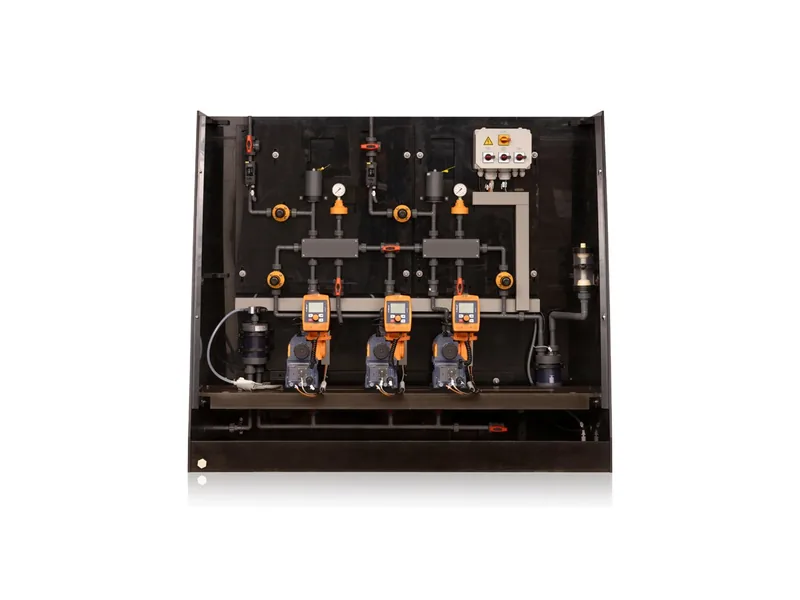
ProMinent supplies pre-assembled dosing panels with pumps, back-pressure valves, pulsation dampers and piping mounted on one board, which is easier to install and maintain than loose components at many dosing points. Larger flows suit motor-driven diaphragm pumps; small antiscalant flows suit solenoid pumps.
The desalination chemical dosing room stores hypochlorite, bisulfite, acid and caustic side by side. Keep them segregated: hypochlorite mixed with acid releases chlorine gas.
Controlling and checking each dosing point
Most desalination chemical dosing points run in flow-proportional mode: the pump follows the feed or permeate flow signal so the concentration stays steady when production changes. Points with a measurable result add a trim. SBS dosing is trimmed by ORP, final caustic by pH, and disinfection by residual chlorine. Antiscalant is usually flow-paced only, because there is no simple online measurement of it in the feed.
Whatever the control mode, check real desalination chemical dosing pump output against the setting with a calibration column at regular intervals. A pump that has lost prime keeps showing a healthy stroke rate on its display while delivering nothing, and membranes pay the price. Flow monitors on the discharge of critical pumps catch this early.
Conclusion
Desalination chemical dosing is one connected chain. Pretreatment biocide and coagulant protect the filters; SBS, antiscalant and pH correction protect the membranes; remineralization and disinfection protect the network. Meter and control each point separately, and specify everything that touches seawater for chloride corrosion. Packaged systems are listed under dosing skids. Send plant capacity plus the chemical and rate at each point, and contact our engineers for a dosing layout.
FAQ
Does every plant need post-treatment remineralization?
Permeate going to a municipal network or long pipelines is usually remineralized to prevent corrosion. Industrial users decide based on their own water specification.
Can antiscalant and sodium bisulfite share one desalination chemical dosing pump?
We would not recommend it. Strength, rate and control logic differ, and mixing them can hurt performance. Give each its own pump.
Can stainless steel pump heads handle seawater?
Ordinary stainless suffers pitting in seawater and high-chloride chemicals. Plastic heads or a seawater-grade alloy are the safer route.
Should hypochlorite be generated on site or bought in?
Large plants running long term often electrolyze seawater on site; small plants find bought-in product simpler. Scale and maintenance capability decide.
What helps when lime slurry lines keep plugging?
Short runs with few bends, enough velocity, and a flushing water connection used after every stop so slurry cannot settle.