
Finished Water Turbidity Monitoring Points: Filters and Clearwell
When a water plant is audited or a customer complains, finished water turbidity is usually the first number asked for. A single meter on the clearwell outlet can still report a value, but by the time that point rises, a filter may already have been leaking for a while. Split the monitoring job: filter effluent catches a single bay, the clearwell shows mixing and residence, and the plant outlet represents water sent to the network. This note is for process and instrument technicians on how to place finished water turbidity points. Application context is in online turbidity monitoring in water treatment. Jumping readings are in turbidity meter reading fluctuating.
Why finished water turbidity needs more than one monitor
Filters are the last process barrier. A sand leak, a poor backwash or an excessive rate shows first on that bay’s effluent. If you only watch the plant outlet, good water from other bays dilutes a bad bay, and by the time finished water turbidity is high you have already lost time. Where it is practical, key bays or every bay should have a turbidity meter. At least put a point on the combined filter outlet and interlock it with backwash and filter-to-waste.
A clearwell mixes and holds water, and it can also reintroduce settled solids or a second contamination. Comparing inlet and outlet turbidity of the clearwell shows whether sludge is building or short-circuiting. The plant-outlet point is the usual official location, but it does not replace filter-effluent control. The three readings will not be identical. Build a site-specific comparison instead of demanding that they match.
Dosing and sludge blows also change how fast these points move. When raw turbidity jumps, look at coagulation and settling first, then at whether finished water turbidity is being held. Do not only raise PAC at the outlet without inspecting the filters. Related dosing is in raw water coagulation with PAC.
How to place filter, clearwell and outlet points for finished water turbidity
Take filter-effluent samples close to that bay’s outlet, with a short, full, vented line so bubbles and wall slime are limited. Installation notes are in the analyzer flow-cell installation guide. One meter per bay versus one on the combined header depends on the number of filters and the level of automation, but you should still be able to tell a single-bay fault from a total-effluent fault.
Do not put the clearwell point in a dead zone or next to an overflow. On a large tank, both inlet and outlet meters are more useful. The plant-outlet point should sit after chlorination and pH adjustment, before the water actually leaves, so unfinished contact time is not reported as finished water turbidity. Choose a low-range meter and calibrate across a few tenths to a few NTU, not as if it were a raw-water instrument.
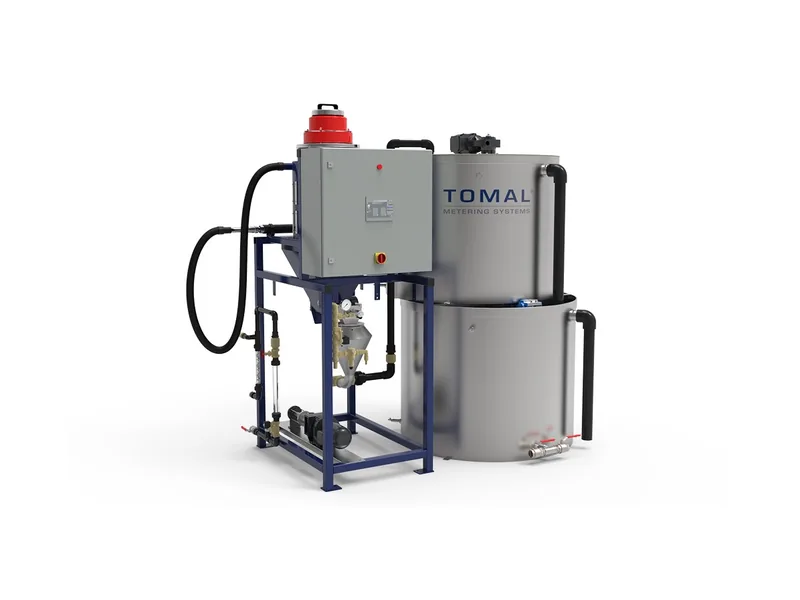
ProMinent analyzers can feed the plant PLC so filter and finished water turbidity trends sit together. Interlocks need a delay and a confirm step, so a short spike from backwash or a bubble does not empty the clearwell or start repeated washes. If polymer is prepared in a unit such as a PolyRex, a change at the dosing point will also move the filter-effluent turbidity curve. Mark that point when you lay out the monitors.
A checklist for finished water turbidity points
Use these points in a design or a retrofit:
Figure 1: ProMinent PolyRex. Image source: ProMinent official website
- Is there bay-level or combined filter-effluent turbidity to guide backwash and filter-to-waste?
- Are the clearwell and the plant outlet both monitored, and is there a site comparison among the three?
- Are sample lines, vents and flow cells suitable for low-range measurement?
- Were the range and the calibration points chosen for finished water turbidity, not raw water?
- Does a high alarm only notify, or does it interlock sludge blows, backwash and filter-to-waste?
See the ProMinent brand pages for instruments. Maintenance intervals can differ by point. Filter effluent is more exposed to air and water hammer and usually needs more frequent checks.
When the readings disagree, separate process from the meter
Low at the filter and high at the outlet can mean clearwell sludge, a second contamination, or bubbles at the outlet. High at one filter and lower at the plant outlet can mean a leaking bay diluted by others, which is easy to miss. Compare with the laboratory before you decide to clean a meter or open a filter. Do not keep changing the finished water turbidity setpoint without that comparison.
Records should show raw, filter-effluent and outlet values together, so a spike can be traced to the raw water or to the filters themselves.
Night-time raw-water changes, or a delayed sludge blow, often lift filter effluent before the plant outlet moves. The shift should watch both trends, not a single finished water turbidity figure. Flush a new sample line thoroughly; construction debris left in the pipe can keep a new point high for days and look like a sand leak.
Conclusion
Finished water turbidity should be read at the filters, the clearwell and the plant outlet together, not from a single outlet meter. The filter point is for process control; the outlet point is for the water sent to customers. Build the comparison on your own plant. Send the number of filters, the existing points and the interlocks, and contact us so we can review the monitoring layout.
FAQ
Can a small plant use only one finished water turbidity point at the outlet?
The outlet point should exist, but a combined filter-effluent meter is still strongly preferred, or a leaking filter will be found late.
Does every filter bay need its own turbidimeter?
Fit per-bay meters if you can; they locate the fault. If not, at least monitor the combined header and add grab samples. Do not rely on the outlet alone.
How large a gap between outlet and filter effluent is normal?
There is no single figure; it depends on clearwell volume and dosing. Build a site baseline and investigate when the gap jumps.
If filter turbidity rises during backwash, is that a finished-water incident?
Backwash and filter-to-waste should be diverted and should not enter the clearwell. If finished water turbidity is already affected, check the valves and the waste path.
Should the outlet point be before or after chlorination?
Official finished water turbidity should represent water that actually leaves the plant, typically after chlorine and pH adjustment, while avoiding bubbles that look like turbidity.