
How to Build a Remote Monitoring Dosing System: Points and Failover
A remote monitoring dosing system sends the running state of a skid to a control room or a more distant platform, and it may allow a limited remote action under a named permission. That is not the same job as the local/remote selector and inverter wiring inside a local control box, which is covered in metering pump control boxes. This page is for people who want remote visibility, or a limited remote change, and who need to settle the points, the communications idea, the permissions and the lost-link rule before they pick a platform.
Points a remote monitoring dosing system should collect
You should at least be able to see pump running and fault, the present stroke or frequency, tank or day-tank level, and any water-quality or flow signal that belongs to this dose line. Without level, a remote view of a running pump may hide a dry tank. Without a fault, a stop may wait until someone walks the room. If a setpoint will be changed from elsewhere, collect the setpoint and the local/remote status as well, so two places do not edit the same value in silence.
More points are not always better. A crowded list makes the comms noisy and the alarms tiring, and the shift then ignores the change that matters. A remote monitoring dosing system should start with the points you would regret not seeing, then add trends and totals if needed. Control background is in dosing system control principles. Sending those values out does not, by itself, add a new control loop.
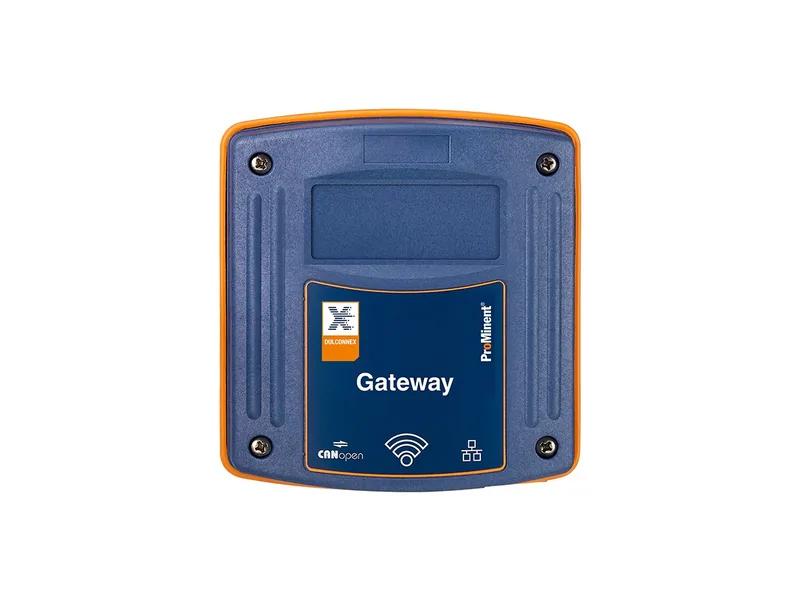
A ProMinent DULCONNEX Gateway is one way to bring field devices onto an upper network. Whether you use a gateway, a PLC or a maker platform depends on the system you already have and on the permission model. Do not stack a second software world just to say you have a remote monitoring dosing system.
Communications, permissions and a lost-link rule
The link may be a field bus, 4-20 mA plus status contacts, or a gateway onto a network. In every case, write who is the master, how long a break counts as a fault, and how clocks stay aligned. Permissions should be split: who may only view, who may change stroke, who may start and stop, who may change an interlock. A remote account must not fight a person at the skid for the same parameter without a record.
Agree the lost-link rule from the process risk:
Figure 1: ProMinent DULCONNEX Gateway. Image source: ProMinent official website
- For a short break, hold the last valid output and alarm both locally and remotely;
- After an agreed time, change to local control or stop the pump, so nobody believes the loop is still in automatic;
- When the link returns, confirm the setpoints so a local change made during the break is not overwritten by an old remote value.
Gateway and software options are listed under gateways and ProMinent. The clauses still have to name the points and permissions for this project. A remote monitoring dosing system with a full screen and no lost-link rule leaves the risk on the cable.
What to prove before the screen goes live
Prove each point against a real value, prove that a fault arrives within the stated time, prove that a remote change writes a log, and prove that a pulled cable makes the unit hold or stop as agreed. For a water-quality or interlock point, also test a bad signal and see whether the pump is driven to an unsafe output.
Names on the screen should match the field labels, and units and ranges should not fight the local display. Later changes to points or permissions should follow a change process; do not quietly add a start/stop account on the platform. After go-live, name who watches the screen and how an alarm escalates. A remote monitoring dosing system with no one on duty is no better than no remote view. Alarm limits should match the field, because a twitchy alarm is usually turned off, and a dull one is missed. When you change a field gauge, compare the remote monitoring dosing system names, units and ranges again. Check gateway power and the network path on the same walk-round as the skid, rather than waiting for a dark screen.
If the plan is unclear, send the present control method and the points you want to see, and contact us to turn the list and the lost-link rule into clauses you can inspect.
Conclusion
A remote monitoring dosing system should fix the points first, then the communications and permissions, and it must say whether a lost link holds the last output, changes to local, or stops the pump. The aim is to see the skid when nobody is in the room, and to know what happens if control is lost, not to build a second local cabinet. Keep the point list sufficient but not noisy, and prove it with live values and a lost-link test. Used that way, a remote monitoring dosing system is something you can trust, while site walk-rounds and the local emergency stop stay in place. Review the lost-link rule after the first month of running a remote monitoring dosing system, because the real break times may differ from the estimate. If the rule is never tested again, the remote monitoring dosing system will quietly drift away from the written failover.
FAQ
Does a remote monitoring dosing system have to live in a cloud platform?
No. Sending the points to the plant control room is often enough. Whether the data leaves the site, and which gateway you use, depends on management and network rules. Do not start with a platform that has no named person on watch.
May I start and stop the pump from a phone?
If you open that, you need strong authentication, a permission model and an action log, and it must still sit with the local emergency stop and the interlocks. In general, viewing is enough; start and stop should stay in the room or the control room.
Is it safe to hold the last output when the link drops?
For a short break it usually is, if you also have a timeout and an alarm. For a toxic or strongly corrosive chemical, a stop after the timeout may be safer. Operations has to decide.
How is this different from the control-box article?
That page covers local wiring, the remote selector and an inverter. A remote monitoring dosing system is about which points you collect, who may change a value, and what happens when the link fails. It does not repeat the terminal rail.
Should water-quality signals go into the remote view as well?
Signals that belong to this dose line should, and you should write what happens if that signal fails. Unrelated water-quality points need not fill the same graphic, or the alarms will typically overload the shift.