
Pulsation Dampener Sizing: Estimate Volume From Stroke Displacement
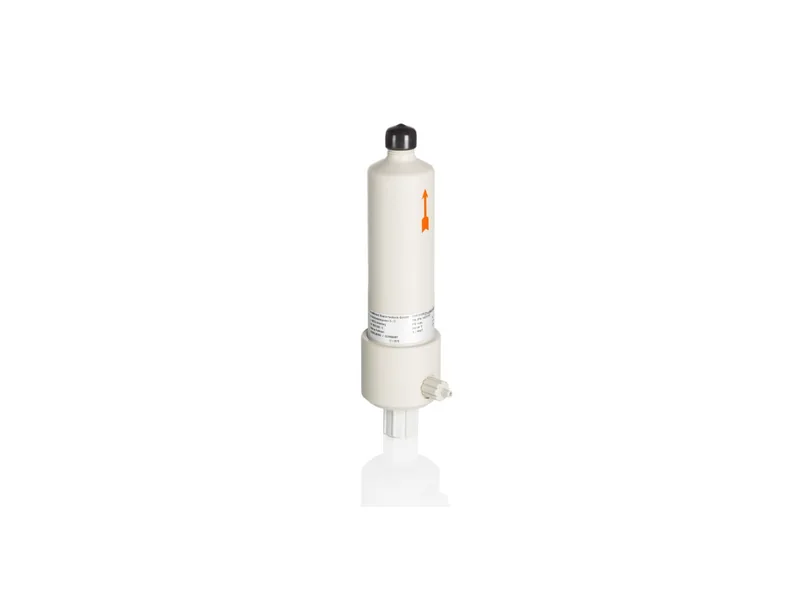
Pulsation dampener sizing comes down to one idea: the gas chamber has to absorb the extra liquid each stroke pushes out above average flow, while keeping the pressure swing inside the limit you set. So you start from stroke displacement, add the allowed pulsation, operating pressure and precharge, back-calculate gas volume with the gas law, and round up to the nearest catalog size.
How a dampener works and where to mount it are covered in separate articles. This one is only about volume, for engineers checking a quote and operators wondering whether the unit on their skid is big enough.
Data you need before pulsation dampener sizing
Collect these first:
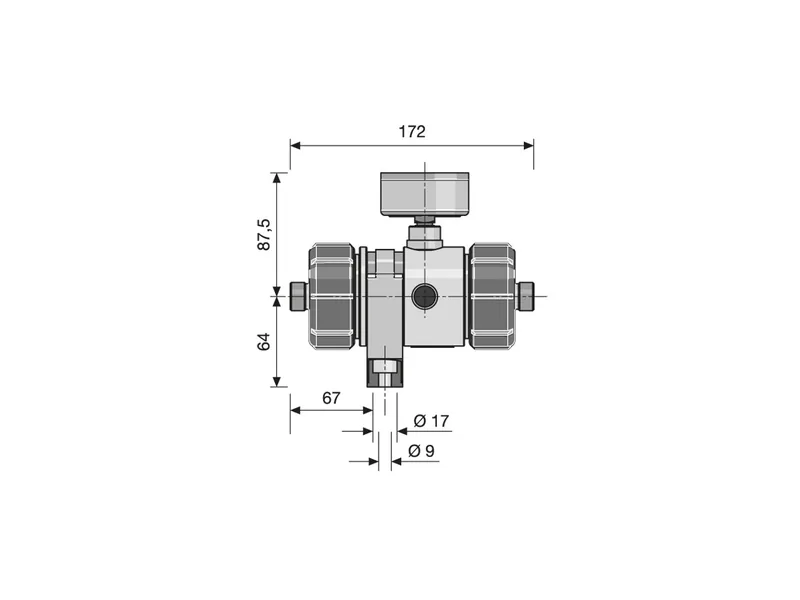
Figure 1: ProMinent inline damper accessory dimension drawing. Image source: ProMinent official website
- Pump rated flow and stroke rate, to get displacement per stroke.
- Number of pump heads and their phasing.
- Operating pressure at the dampener and the allowed residual pulsation, for example ±5% or ±10%.
- Intended precharge pressure, normally set relative to operating pressure.
- Fluid temperature and stroke speed, which decide whether an isothermal estimate is good enough.
Without an allowed pulsation figure, pulsation dampener sizing has nothing to size against. A lot of inquiries just say "need a dampener," and the supplier ends up guessing.
Step 1 of pulsation dampener sizing: displacement per stroke
Displacement per stroke ≈ rated flow ÷ strokes per minute ÷ 60, with flow in L/h. Converting to mL makes the number easier to work with.
Example, with assumed numbers: a pump rated 60 L/h at 60 strokes per minute displaces about 60 ÷ 3600 L, or roughly 16.7 mL per stroke. If the pump runs at short stroke length the real displacement is smaller, but pulsation dampener sizing should use full stroke, or the unit will be undersized the day someone turns the pump up.
Step 2: Excess volume, not total displacement
During discharge, a reciprocating pump's instantaneous flow runs above the average. Only that excess has to be stored. For a single-head, single-acting pump, a common estimate is about 0.6 of stroke displacement. With two heads running 180° apart the fraction drops considerably, which is why a duplex pump typically needs a much smaller dampener for the same total flow.
In our example the excess volume is about 0.6 × 16.7 ≈ 10 mL. For background on where pulsation comes from, see is diaphragm pump flow continuous.
Step 3: Back-calculate gas volume
Treating the gas as isothermal, pressure times volume stays roughly constant. With precharge p0 and precharge gas volume V0, and the low and high pressures of the allowed swing p1 and p2:
ΔV = p0 × V0 × (1/p1 − 1/p2), so V0 = ΔV ÷ [p0 × (1/p1 − 1/p2)].
Continuing the example: 5 bar gauge is about 6 bar absolute. Allowing ±5% gives p1 ≈ 5.7 and p2 ≈ 6.3 bar absolute. Set precharge around 80% of p1, about 4.6 bar absolute. Then 1/p1 − 1/p2 ≈ 0.0167 per bar, times p0 gives about 0.077, and V0 ≈ 10 ÷ 0.077 ≈ 130 mL.
At fast stroke rates the gas has no time to exchange heat, so compression is closer to adiabatic and the required volume grows. In practice, pulsation dampener sizing then adds margin and moves up one catalog size.
Common mistakes in pulsation dampener sizing
These turn up again and again when we review existing installations:
- Using gauge pressure as absolute. At low pressure the error is huge: 1 bar gauge is about 2 bar absolute, double the number.
- Sizing on average flow instead of full stroke.
- Treating a duplex pump as simplex and buying a dampener far bigger than needed.
- Leaving the precharge at the factory value. Too high and the bladder barely moves at operating pressure; too low and it bottoms out. Either way the dampener does almost nothing.
A further trap is a system whose pressure changes a lot between operating cases, for instance a line that doubles in pressure between day and night. Size for the worst case and consider a design whose precharge can be adjusted on site.
Does oversizing make pulsation dampener sizing safer?
No. An oversized gas chamber has to fill before pressure builds, so at startup the pump delivers less than set for a while. Small intermittent pumps notice this most. Large housings also narrow your choice of pressure rating and material, and take up more space on the skid.
Size to the calculation plus reasonable margin, not three times bigger "just in case." Keep the pulsation dampener sizing worksheet with the project file so it can be rechecked when conditions change.
Using a manufacturer's accessory data
ProMinent, among others, lists pulsation dampeners (pressure accumulators) in its accessory range with volume, pressure rating and materials. Work out V0 first, then pick the size whose volume is at least the calculated figure, whose rating exceeds the maximum system pressure, and whose wetted materials suit the chemical. Hypochlorite, acids and caustic each put different demands on bladder and body, so check compatibility separately. See our dosing accessories range and the ProMinent brand page.
Conclusion
The order for pulsation dampener sizing is: displacement per stroke at full stroke, excess volume by number of heads, then the gas law with allowed pulsation, operating pressure and precharge, then an adiabatic allowance and the next size up. Use absolute pressure throughout and set precharge from operating pressure. For the theory and the installation side, read how a pulsation dampener works and dampener placement and precharge. Send your pump model, stroke rate, line pressure and allowed pulsation, and contact our engineers for a sizing check.
FAQ
Is pump flow alone enough for pulsation dampener sizing?
No. You also need stroke rate, number of heads and the allowed pulsation. Two pumps with the same flow can differ several times in displacement per stroke.
What residual pulsation should pulsation dampener sizing allow for?
It depends on what sits downstream. Flow meters and precise injection call for a tighter limit; simply stopping pipe vibration allows a looser one.
Why does precharge depend on operating pressure?
Precharge decides how far the bladder compresses in service. Mismatch it and the gas either never moves or collapses completely, whatever the volume.
Can two small dampeners replace one large one?
They can, but it is rarely worth it. Precharge and volume must be recalculated for the pair, and placement affects the result. One correctly sized unit is simpler.
My pulsation dampener sizing result falls between two sizes. Which do I pick?
Usually the larger one. A small margin covers higher stroke rates or pressure swings, but there is no need to jump several sizes.