
Antiscalant Dosing System: RO Pretreatment and Cooling Water
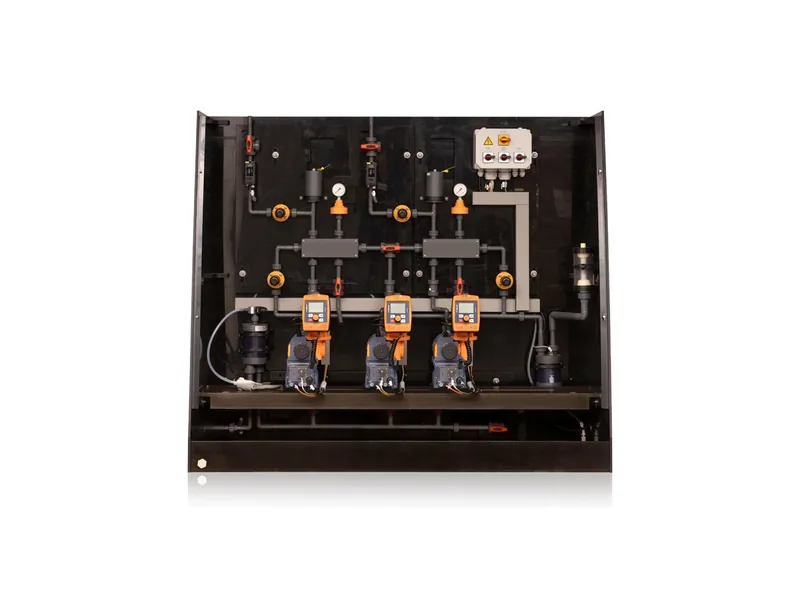
An antiscalant dosing system exists to feed scale inhibitor in proportion, without interruption, so calcium, magnesium and silica stay in solution instead of depositing. On a reverse osmosis train it protects the concentrate side of the membranes; on a cooling circuit it protects exchangers and piping. This page is for water-treatment operators and for engineers laying out an RO or cooling-water package, and it stays with duty, components, injection points and interlocks.
What an antiscalant dosing system does on an RO train
Reverse osmosis forces water through a membrane and leaves salts on the concentrate side. Downstream elements see a higher concentration, and calcium carbonate, calcium sulfate, barium sulfate or silica can drop out once they exceed solubility. The usual signs are falling permeate flow, a rising inter-stage pressure drop, weaker salt rejection and more frequent cleanings.
The inhibitor delays crystal growth long enough for the salts to leave with the concentrate. The antiscalant dosing system has to start as soon as the high-pressure pump starts, stop when the train stops, and hold a steady dose in between. A missed feed period is often more damaging than a slightly high dose.
Cooling-water duty for an antiscalant dosing system
A cooling tower concentrates dissolved solids as water evaporates. Once cycles of concentration rise, exchanger tubes start to scale. Cooling-water antiscalants, often blended with corrosion inhibitors, keep that under control within a designed cycle range.
Unlike RO, an antiscalant dosing system on cooling water is rarely a simple pump-on, pump-off interlock. Dose usually tracks make-up flow or blowdown. When make-up increases, inhibitor has to follow; when blowdown increases, inhibitor is lost and must be replaced. The split of scale, corrosion and biocide duty is covered in cooling-water dosing principles.
Parts of a typical antiscalant dosing system
A common antiscalant dosing system includes:
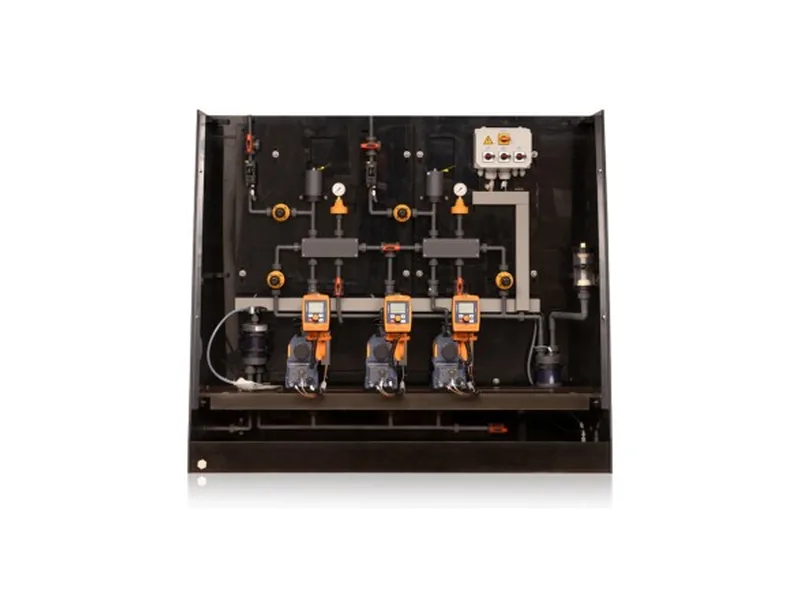
Figure 1: ProMinent DULCODOS panel metering station front. Image source: ProMinent official website
- A PE tank with a level sensor, a mixer if the product is diluted, and a low-level alarm.
- Metering pumps, preferably one duty and one standby. Small RO trains often use a solenoid-driven pump; larger flows use a mechanical diaphragm pump.
- Discharge accessories: a relief valve, a back-pressure valve, a pulsation dampener and a gauge, plus a suction strainer.
- A calibration column to check actual pump delivery.
- A control panel that accepts run and 4-20 mA signals and reports run or fault status.
Do not omit the back-pressure valve. The usual RO injection point is upstream of the cartridge filter, where line pressure is modest. Without back pressure the pump can siphon or overfeed. Packaged panels such as ProMinent's DULCODOS panel are modular metering stations; the official page describes a ready-to-connect unit with up to three low-pressure pumps, one of them a standby, and optional flow measurement for cooling water, reuse and power-plant duty.
Where to inject
Reverse osmosis
Feed the inhibitor upstream of the cartridge filter so it mixes on the way through and so any solids in the chemical are caught. If a reductant such as sodium bisulfite is used to remove chlorine, keep the two injection points a pipe length apart so the chemicals do not meet at the wall. Use an injection valve that reaches the center of the pipe, not a wall tap.
Cooling water
Add inhibitor in a well-mixed part of the basin, or on the make-up line. Keep it away from the blowdown nozzle, or the chemical leaves before it is mixed. Supply-versus-return injection is discussed in dosing point: supply or return.
Interlocks that prevent missed or excess feed
On RO, the usual interlock starts and stops the antiscalant dosing system with the high-pressure pump or feed pump. A low-level alarm warns the operator; a low-low level stops the metering pump and, on some plants, trips the RO train. Whether a loss of inhibitor is a hard trip depends on the owner's operating rule.
Cooling water is different. The pump frequency often tracks make-up flow, or it follows a conductivity blowdown signal. When conductivity hits the set point, the blowdown valve opens, make-up comes in, and inhibitor is replaced in proportion to that make-up.
Field gaps that show up again and again
- A pump that is far too large for a tiny dose, running at a very short stroke and delivering an unsteady flow. Low-flow practice is in RO antiscalant low-flow dosing.
- An open tank that lets debris into the check valves.
- Dilution water that is hard, so the inhibitor reacts in the tank and leaves sludge on the floor.
- Solution left in the line after a shutdown, then precipitating in cold weather and blocking the injection valve.
Most chemicals used in an antiscalant dosing system are weakly acidic or near-neutral. Rinse splashes promptly, and depressurize the line before you open it.
Conclusion
An antiscalant dosing system keeps inhibitor flowing, in proportion, into an RO or cooling-water circuit so membranes and exchangers do not scale. Get the tank, a duty/standby pump, a back-pressure valve and the panel right; place the injection point where mixing is good; interlock RO feed with the high-pressure pump and cooling-water feed with make-up or blowdown. Compare packaged units on the dosing skid page and brand data on the ProMinent page. Send us the water flow, the recommended dose and the available control signals, and contact our engineers to size a set.
FAQ
Should antiscalant be diluted before it is fed?
Only if the neat dose is too small for the pump to run stably. If the volume is enough, feeding neat chemical is simpler.
Can antiscalant and biocide share one tank?
No. The two products can interfere, and you cannot adjust them separately. Give each chemical its own antiscalant dosing system tank and pump, or a dedicated biocide set.
Should the antiscalant pump stop when the RO train stops?
Yes. Interlock it with the feed or high-pressure pump, or the chemical keeps entering a unit that is not running.
How many pumps should an antiscalant dosing system have?
One duty and one standby is the usual arrangement. A continuous RO train scales quickly if feed is lost, and the standby covers service on the duty pump.
How do I know the dose is enough?
Watch the process and the lab results. On RO, follow inter-stage pressure drop and permeate flow. On cooling water, use coupons, exchanger condition and water analyses.