
Cooling Water Dosing Point: Supply Line or Return Side?
The best cooling water dosing point in an open recirculating system is usually on the return side, in the tower basin close to the circulating pump suction. Pressure is lowest there, mixing is fast, and the chemical spreads through the whole loop within one pass of the pump.
Drawings often show the dosing point as a single arrow, and on site the contractor, the chemical supplier and the equipment vendor may each say something different. Below we cover open systems and closed loops separately, then the cases where a dedicated injection point makes sense. Two terms first: supply means cold water leaving the circulating pump for the heat exchangers, and return means warm water heading back to the tower.
Open systems: where the cooling water dosing point belongs
Why the basin near pump suction wins
The basin holds the bulk of the water at the lowest pressure in the loop. Chemical added there is pulled into the pump and mixed before it reaches any exchanger. The metering pump only has to overcome a short discharge line, so a low-pressure solenoid pump is usually enough.
Keep the cooling water dosing point away from dead corners of the basin, where mixing is slow and local concentration climbs. Keep it away from the make-up inlet and the overflow too, or part of the dose leaves with blowdown before it ever reaches the pump.
Why not the return header before the tower
Return water goes to the distribution deck at the top of the tower. Chemical added there runs over the fill and part of it is lost as drift. Oxidizing biocides such as sodium hypochlorite also lose free chlorine faster in all that air contact. So in an open system, "return side" really means the basin under the tower, not the warm return pipe.
When the supply line makes sense
The supply line is the highest-pressure point, so a cooling water dosing point there needs a higher-pressure pump and a proper injection valve. It is typically used in two cases: shock biocide for one critical exchanger, or a basin that cannot take a dosing nozzle. Put the injection point downstream of the pump discharge valve, with a decent straight run before the exchanger.
What about the make-up line?
Dosing into make-up water sounds neat, since dose follows make-up flow. In practice make-up is intermittent. When the level control shuts the valve, dosing stops too and loop concentration swings. The make-up line is a better cooling water dosing point for pretreatment chemicals than for the loop program itself.
Closed loops: return header before the pump
A closed loop has no open basin. The lowest-pressure point is usually the return header just ahead of the circulating pump suction, so that is where the cooling water dosing point typically goes, either as a valved nozzle or through a bypass pot feeder.
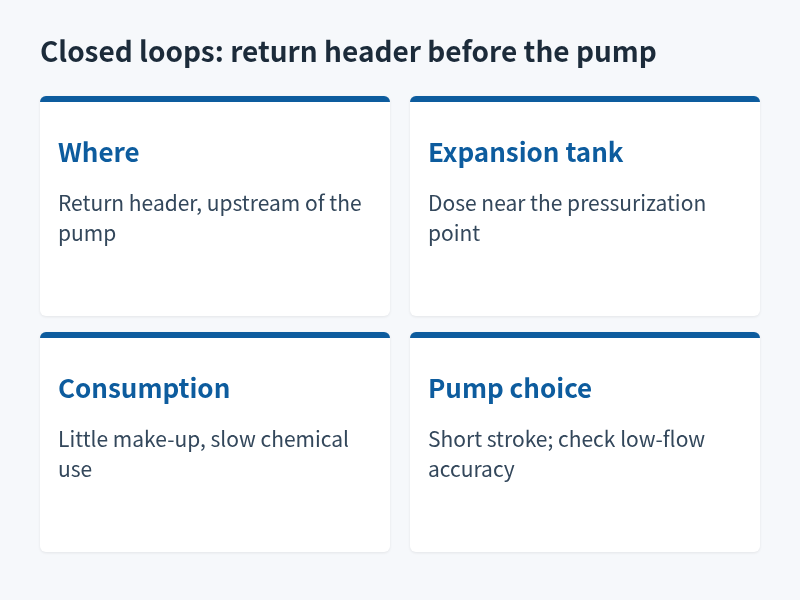
Figure 1: In a closed loop with an expansion tank, dosing near the pressurization point avoids local pressure swings.
- If the loop has an expansion or pressurization tank, keep the dosing point close to it to avoid pressure swings.
- Closed loops lose little water, so chemical demand is small and the pump often runs at a short stroke. Check accuracy at low flow when sizing.
Separate nozzles for separate chemicals
Scale and corrosion inhibitors can share an area, but give each its own nozzle with some distance between them. Oxidizing biocide can react with some phosphonate inhibitors, so nozzles placed too close cut the effect of both.
Acid for pH control and sodium hypochlorite must never share a cooling water dosing point or meet in a common line. Mixing them releases chlorine gas, and this is a real incident type on site. The role of each chemical is explained in cooling water dosing principles.
Placing the skid and the injection hardware
Once the cooling water dosing point is fixed, put the skid close to it. Keep suction lines short, and fit a back-pressure valve on long discharge runs to stop siphoning. For ventilation, corrosion and service access see dosing system installation location. Use a check-type injection valve so loop water cannot back up into the chemical line, as described in metering pump injection valves, with parts listed under dosing accessories.
Safety note: before moving a dosing point, stop the pump, close the valves on both sides of the injection valve and relieve line pressure.
Checking the result after start-up
Take samples at the exchanger farthest from the dosing point and test chemical residual, with conductivity and free chlorine as supporting checks. A large gap between near and far readings means poor mixing, and the cooling water dosing point should move closer to pump suction.
A common retrofit pattern
A pattern we see on retrofits: inhibitor is dosed on the warm return pipe a few meters before the tower. Residuals at the far exchangers stay low and the supplier keeps raising the dose. Moving the cooling water dosing point into the basin, close to the pump suction screen, typically brings the far readings up toward the near ones, and the dose can come back down. Short. Simple. Cheaper than more chemical.
Conclusion
The right cooling water dosing point depends on the system. Open towers dose in the basin close to the circulating pump suction. Closed loops dose on the return header ahead of the pump. Use the supply line only for targeted shock treatment or when the basin has no usable nozzle, and raise the pump pressure rating to suit. Send your flow diagram and chemical list through our contact page and we will help place the dosing point and pick the pump.
FAQ
Is chilled water treated the same way?
Chilled water is a closed loop, so treat it like one. Dose on the return header before the pump or use a bypass pot feeder.
Can we just pour chemical into the tower basin?
It works as a short emergency fix, not as a routine. Manual dosing swings concentration and wastes chemical.
Will dosing at pump suction harm the circulating pump?
At normal treatment levels the effect is small. Keep the nozzle from pointing straight into the pump inlet and leave some mixing distance.
What pressure rating does a supply-line dosing pump need?
It depends on supply pressure plus the injection valve cracking pressure. Choose a pump rated somewhat above that sum.
How many dosing points can one system have?
Usually around two or three, one per chemical family. Keep a separate nozzle for shock biocide.