
PCB Chemical Dosing System: Central Make-Up and Multi-Point Feed
A PCB chemical dosing system centralizes acid, caustic, coagulant, polymer and decomplexing agents in one chemical room, then sends each chemical to the reaction tanks on every treatment line with its own metering pump. It has two jobs: automatic make-up so day tanks never run dry, and multi-point feed so every tank gets the right dose regardless of what the others are doing.
Printed circuit board plants split wastewater into many streams, such as copper rinse, complexed copper, ink and acid/alkali, and each stream has its own pH adjustment, decomplexing, coagulation and flocculation stages. With that many injection points, scattered drums beside each tank become hard to manage. This guide is for EHS managers, plant engineers and contractors planning a new or upgraded wastewater station. We follow the chemical from make-up to storage, transfer, injection and control.
Why centralize a PCB chemical dosing system
The typical decentralized setup has a small drum next to each reactor, mixed by hand. Strength varies from batch to batch, the area around each drum corrodes, and one missed refill on a shift change can push discharge out of limits. Centralizing means chemicals are unloaded, diluted and stored in one place. Operators handle acid and caustic less often, and chemical use can be tracked per line.
There is a price. Lines get longer, pumps sit farther from injection points, and friction loss and back pressure need recalculating. A power cut or empty tank in the chemical room now affects the whole plant, so standby pumps, spare storage and alarms belong in the design from day one.
Automatic make-up in a PCB chemical dosing system
Liquid chemicals
Sulfuric acid, caustic soda and liquid PAC usually arrive by tanker and go into bulk tanks before dilution. Each dilution tank gets high and low level switches: at low level, the make-up water valve and the concentrate transfer pump open; at high level, both stop. Strength comes from the ratio of concentrate to water, which you calibrate on site and then lock into the program.
Powdered polymer
PAM is often supplied as powder and needs a dry feeder, mixing tank and aging tank before transfer to storage. Our article on how an automatic chemical dosing system works covers the three-chamber layout.
A common mistake at this stage is the wrong level switch. Float switches tend to foul in polymer tanks, and switch materials in sulfuric acid tanks need checking against the concentration; follow the product data for your switch.
Two multi-point layouts for a PCB chemical dosing system
One pump per injection point
Each point has its own metering pump drawing straight from a storage or day tank. Flow at each point is set independently and a failed pump affects only one tank. The NEWDOSE mechanical diaphragm pump manual is direct about this: when one pump feeds several points, even a small pressure difference sends more chemical to the lowest-pressure point, so accuracy cannot be held. It recommends one pump per injection point, and most PCB chemical dosing system designs follow that rule.
Ring main with local metering
A transfer pump circulates chemical through a pressurized loop, and each reactor has a local metering pump drawing from the loop. This suits a large PCB chemical dosing system with many widely spaced points. Keep the loop pressurized and returning to the tank so chemical does not settle or crystallize in the pipe. Local pump suction pressure will move with the loop, so add pressure stabilization if needed.
As a rule of thumb, few points close to the chemical room means one pump per point; many points spread across the site means a ring main. More on pump arrangements is in our guide to duty/standby versus multi-point dosing.
Control logic for each pump
Each reactor normally has its own pH or ORP analyzer feeding the PLC, which sends a 4–20 mA or pulse signal to the matching pump. Points to build into a PCB chemical dosing system:
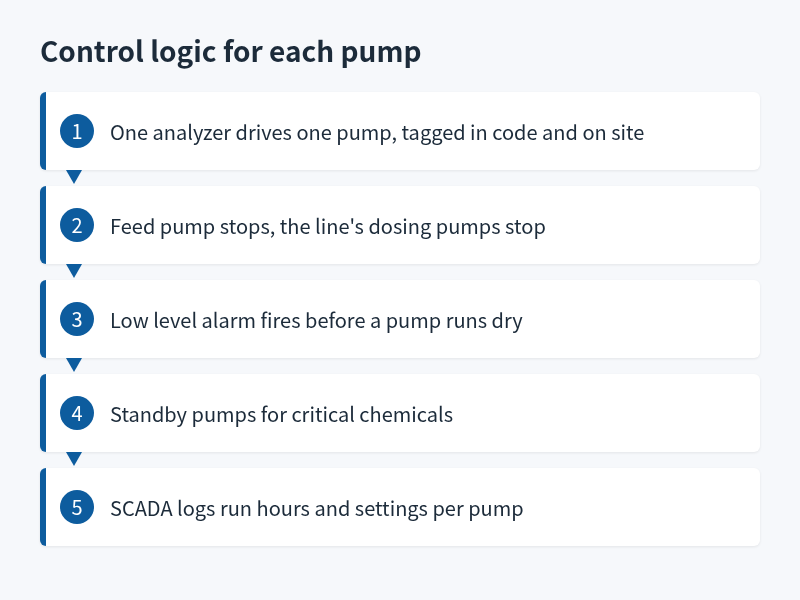
Figure 1: Pairing each analyzer with one tagged pump prevents acid and caustic being dosed the wrong way round.
- One analyzer drives one pump. Tag numbers match in the program and on site labels, so acid and caustic are never swapped.
- When a line's feed pump stops, its dosing pumps stop too, so no chemical goes into an empty tank.
- Low level alarms on storage tanks trip before pumps run dry, leaving time to make up a new batch.
- Critical chemicals such as caustic and decomplexing agent get a standby pump with automatic or quick manual changeover.
- The SCADA logs run hours and setpoints per pump, so chemical use can be billed to each line.
For a fuller treatment of interlocks, see PLC and pump logic for wastewater dosing.
Materials and safety in a PCB chemical dosing system
Almost every chemical in a PCB wastewater plant is corrosive. Choose pump heads, pipe and valves by chemical: PVC or PVDF is common for sulfuric acid, caustic and PAC, and metal is a poor choice around oxidizers. Color-code or label every line, and avoid running acid and caustic on the same tier of a shared pipe rack.
Before opening any line in a PCB chemical dosing system, stop the pump, close both isolation valves and release pressure. Wear a face shield, acid-resistant gloves and apron. Bulk acid and caustic tanks need bunding and an eyewash station.
Conclusion
A good PCB chemical dosing system makes up chemicals centrally and doses them separately by line. Use level interlocks for automatic make-up, prefer one pump per point, and switch to a ring main only when points are many and far apart. Tie each pH/ORP signal to its own pump and keep standby pumps on critical chemicals. Browse our dosing skids and pH/ORP analyzers, then send us your wastewater streams, chemicals and injection point locations and contact our engineers for a chemical room layout and pump list.
FAQ
Does a PCB chemical dosing system need a PLC?
For many injection points, yes. A small system with a few pumps can run on standalone controllers, but interlocks and records will be weaker.
Can one large pump split flow to several tanks?
Not recommended. Each branch sees different back pressure, and the lowest one takes more chemical.
How many days of storage should the chemical room hold?
It usually depends on delivery lead time and daily use, plus time to make up a new batch.
Can caustic and decomplexing agent share a line?
No. Mixed chemicals can react or crystallize in the pipe, so give each chemical its own line.
Can existing pumps be reused when upgrading to a central PCB chemical dosing system?
Often, yes. Check flow, pressure rating and head material against the new line back pressure first.