
dosing-system-insulation-heat-tracing
title: Dosing System Heat Tracing for Cold Climates: Where to Start description: Where dosing system heat tracing matters most, from calibration columns and suction lines to injection points, plus enclosure options, chemical limits and level sensors. date: 2026-10-29 category: Technical Articles keywords: [dosing system heat tracing, chemical feed system freeze protection, dosing skid insulation, low level sensor cold weather]
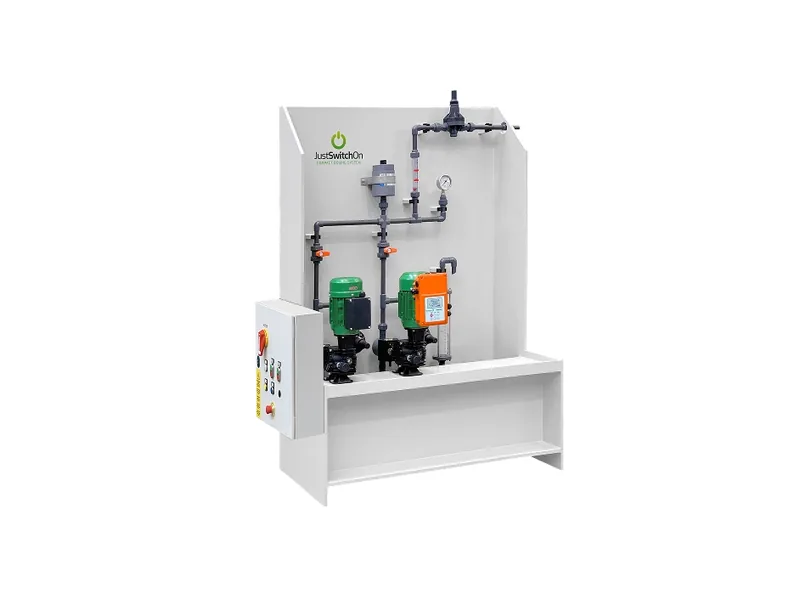
Dosing system heat tracing should start with the thinnest, least-moving parts of the line, not with the chemical tank. In our experience the tank is rarely the first thing to freeze; the calibration column and the gauge line usually are.
This article is for operators and designers of outdoor dosing skids at water plants, power plants and remote sites in cold regions. It walks along the chemical path and explains what to trace, what to enclose and what to watch.
Map the line before planning dosing system heat tracing
A typical skid runs from the tank through an isolation ball valve, a Y strainer and a calibration column into the pump. After the pump come a pulsation dampener, back pressure valve, relief valve and pressure gauge, then the line to the injection point. Doseuro's pre-engineered JSO systems are a good reference: their catalog describes a PP frame for single or dual pumps, suction piping with isolation ball valve, Y filter and calibration pot, and discharge piping with isolation valves, pulsation dampeners, back pressure valve, relief valve and pressure gauge.
Ranked by freezing risk, here is where dosing system heat tracing pays off first:
- Calibration column and gauge lines: small bore, no flow, first to freeze.
- Suction line and Y strainer: chemical sits still when the pump stops, and a frozen screen blocks flow.
- Pump head and check valves: ice holds the balls, and the pump will not prime.
- Discharge line and injection point: long exposed runs, especially through walls and on racks.
- Tank: large volume cools slowly, but crystallization of concentrates is the hardest to clear.
Three dosing system heat tracing options
Put the skid indoors if you can. A heated dosing room above freezing is the simplest option and needs the least maintenance.
If indoor space is not available, two approaches are common:
- Insulated enclosure: the whole skid sits in an insulated cabinet with a small heater and thermostat. Good where pumps and valves are grouped, and service access is easy.
- Electric tracing plus insulation: tracing cable on the pipe, then insulation and a metal jacket. Good for long discharge runs and injection lines. Self-regulating cable is generally preferred because local overheating is less likely.
Many sites combine them, with the skid in an enclosure and dosing system heat tracing on the long lines outside it. Cable output and insulation thickness depend on your design minimum temperature and pipe size, so calculate them per project.
Chemicals have their own cold-weather limits
Dosing system heat tracing is not only about ice. Each chemical behaves differently:
- Concentrated caustic can crystallize well above freezing and block suction lines and valve seats.
- Polymer solution thickens in the cold, and suction lift drops noticeably.
- Urea solution crystallization depends on concentration; follow the supplier's data for outdoor tanks.
- Sodium hypochlorite has the opposite problem: too much heat speeds decomposition and gas bubbles appear in the line.
So set the thermostat by chemical, not by the idea that warmer is better. For hypochlorite, keep the setpoint just high enough to prevent freezing. Our winter dosing antifreeze article covers more seasonal measures.

Figure 1: Doseuro dosing unit with mixer and metering pump. Image source: Doseuro official website
Low level sensors and dosing system heat tracing
Level sensors cause many winter trips. Most are avoidable. A float switch can stick when the surface ices or crusts, showing liquid while the pump is actually running dry. A conductive probe coated with crystals may report low level constantly and keep the pump locked out.
What helps:
- Include the tank area where the sensor sits in the heated zone, not just the piping.
- Check float-to-stem clearance; for crystallizing chemicals choose designs that shed deposits.
- Seal junction boxes well, since winter condensation inside a box can also cause false alarms.
- Pull the low level test by hand once a week to confirm alarm and pump interlock still work.
For alarm and interlock wiring see low level alarm setup, and for sensor options browse level switches. Doseuro dosing tanks have a transparent level indicator, with sizes listed from 100 to 1,600 liters, so a quick visual check during rounds can confirm what the sensor says.
Monitoring and winter rounds
Two failures hurt most in dosing system heat tracing: a broken tracing circuit that nobody notices, and a stuck thermostat that never switches off. A safer design adds current monitoring or a fault alarm on each dosing system heat tracing circuit, wired to the control panel, plus a temperature sensor inside the enclosure with both low and high alarms.
On rounds, check four things: damaged or wet insulation, discolored tracing connections, movement in the calibration column, and a sensible pressure gauge reading. Cold-region sites typically do a full inspection before winter and recheck insulation after the spring thaw. During the first winter, log enclosure temperature weekly to confirm the setpoint is right for your dosing system heat tracing.
Conclusion
Start dosing system heat tracing at the smallest, stillest sections: calibration column, gauge lines, suction line and strainer. Trace the discharge and injection lines, and move the skid indoors where possible. Set temperatures by chemical, since caustic fears cold and hypochlorite fears heat. Keep level sensors inside the protected zone and test the interlock regularly. For a design matched to your climate and chemicals, contact us, or browse packaged dosing skids from brands such as Doseuro.
FAQ
Is an enclosure or tracing cable better for dosing system heat tracing?
An enclosure suits grouped pumps and valves; tracing with insulation suits long pipe runs. Most cold-climate sites use both.
Should I drain the skid during a long winter shutdown?
If there is no tracing, yes. Drain the suction line, calibration column and pump head, then flush with clean water to prevent cracking and crystallization.
Why does my low level sensor false alarm in winter?
Typically crystals on the probe, an iced float or condensation in the junction box. Clean the sensor first, then check the box seal.
Does a hypochlorite dosing line need heat tracing?
In freezing climates it generally does, but with a low setpoint. Excess heat speeds decomposition and causes gas bubbles.
How can I tell if tracing cable has failed?
Add current monitoring or a fault alarm to each circuit and wire it to the panel, with a low temperature alarm in the enclosure.