
Centrifuge Polymer Dosing: Dose Rate and Injection Point Guide
Centrifuge polymer dosing is harder than it looks because of shear. A decanter spins fast, and the moment sludge enters the bowl it meets intense centrifugal force and shear. Floc that is not strong enough breaks apart and fine solids leave with the centrate. That is why centrifuge polymer selection, injection point and dose all revolve around one question: does the floc survive once it is inside the bowl? This guide is written for operators and commissioning engineers running decanter centrifuges on sludge.
What a decanter needs from the polymer
In a decanter centrifuge, sludge enters through the feed tube into the bowl. Solids are thrown against the bowl wall, the scroll turns at a small differential speed to push the settled cake up the conical beach, and liquid overflows at the other end. The whole process takes seconds, so the floc has to settle quickly and then withstand the squeezing and shear of the scroll.
Centrifuge polymer therefore tends to be a high molecular weight cationic grade with medium to high charge, producing small, dense floc rather than the large, open floc a belt press prefers. Switching a belt press product straight onto a centrifuge commonly gives cloudy centrate and high polymer use.
Internal or external injection
There are two usual injection locations:
Figure 1: ProMinent Polyrex batch polymer preparation unit. Image source: ProMinent official website
- External injection: polymer goes into the sludge feed line and through an inline mixer before the machine. Contact time is longer, which suits slow-flocculating sludge, but the floc is sheared again in the feed tube and distributor.
- Internal injection: polymer is delivered through the machine's own feed tube into the feed zone and meets the sludge at the bowl inlet. Floc starts settling as soon as it forms, shear losses are lower, and many sites use less polymer this way.
Many centrifuges offer both connections. During commissioning, try both and compare centrate clarity and polymer consumption, running each for at least a full shift on the same sludge and machine settings. Some plants split the dose, pre-mixing most of the centrifuge polymer externally and trimming internally.
Tuning the centrifuge polymer dose
The starting dose comes from dry solids, as with any dewatering machine: sludge flow times solids content gives dry solids, multiplied by polymer use per tonne. See PAM dosage ranges for typical figures.
On the machine, judge the dose from several signals together:
- Centrate: cloudy, with fines, means too little polymer or floc that is being destroyed.
- Torque: steady at the right dose; heavy overdosing makes cake sticky and torque may rise.
- Cake: wet or soft cake may need a better match between differential speed and pond depth, or a more shear-resistant grade.
- Consumption: adding more polymer after the centrate is already clear is waste.
Make small changes and let the machine settle before judging, as described in adjusting PAM pump dose. Differential speed and pond depth change how the dose appears to perform, so avoid large changes to the machine and the centrifuge polymer dose at the same time.
Thickening centrifuges are different
Not every decanter dewaters. Some thicken sludge before digestion. A thickening centrifuge needs far less centrifuge polymer, and some run without any. The target there is a pumpable thickened sludge and a clean centrate, not a dry cake. Do not copy a dewatering dose to a thickening machine.
Make-down and feed pumps
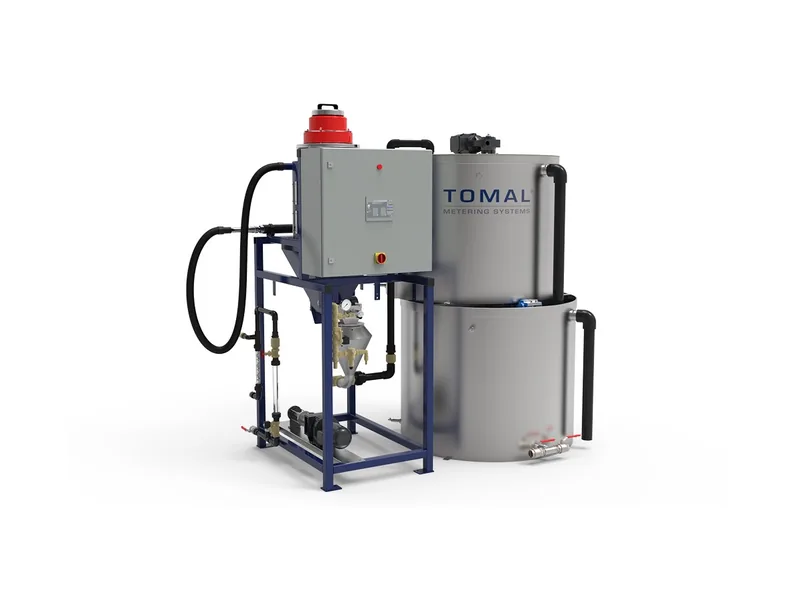
Centrifuges run continuously and use a lot of polymer, so automatic make-down units are the norm, with solution strength typically around 0.1–0.3% and enough aging time. System sizing is covered in integrated PAM dosing system selection. The ProMinent Polyrex is a batch-type polymer preparation unit that dissolves and ages solution in batches, useful where a very steady concentration matters; see the ProMinent brand page and the dosing skid category for other configurations.
Feed pumps are usually progressing cavity or diaphragm metering pumps, ideally paced from the centrifuge feed flow. With internal injection, the pump must overcome the resistance of the machine's feed line, so keep the line short with few bends.
Common centrifuge polymer problems
What operators run into most often:
- Cloudy centrate: underdosing, a grade with poor shear resistance, or an external injection point so far upstream that the floc breaks in the pipe.
- High polymer use: try internal injection, or rescreen higher molecular weight grades.
- Wet cake: both chemistry and machine settings play a part. Fix machine settings while tuning the dose, then fix the dose while tuning the machine.
- Blocked polymer line: undissolved particles in the solution; check dissolving and screening in the make-down unit.
A centrifuge runs at high speed. Before clearing polymer lines or inspecting the feed tube, stop the machine, wait for the bowl to come to a complete stop, and isolate and lock out power.
Conclusion
Effective centrifuge polymer dosing starts with a shear-resistant grade that forms dense floc. Compare internal and external injection on site, start the dose from dry solids and refine it with centrate, torque and cake, and use a make-down unit that keeps concentration steady and aging complete. Tune the polymer and the machine separately so the results mean something. Send your sludge type, centrifuge model and throughput through the contact page and we will review feed pumps and make-down equipment.
FAQ
Can a centrifuge use the same polymer as a belt press?
You can try, but results usually differ. A centrifuge needs dense, shear-resistant floc, so screen grades separately.
Is internal injection always better?
No. It often saves centrifuge polymer because of lower shear, but slow-flocculating sludge may do better with external pre-mixing.
Cloudy centrate: adjust polymer or machine first?
Hold the machine settings and step the dose up from low; once the dose is right, adjust differential speed and pond depth.
What pump suits centrifuge polymer feed?
A progressing cavity pump or a diaphragm metering pump with large valves, preferably paced by sludge feed flow.
Why does a centrifuge use more polymer than a belt press?
Higher shear demands stronger floc, so consumption tends to be higher; the right grade and injection point can bring it down.