
Antiscalant Dosage Calculation: From ppm to Pump L/h
An antiscalant dosage calculation starts with a number you usually do not choose yourself. The chemical supplier runs projection software on your water analysis and gives a design dose in ppm (mg/L). Your job is to turn that ppm into litres per hour at the pump, set stroke and speed, then verify with a calibration column. The core formula is short: pump flow = water flow × dose ÷ chemical content per litre of solution. This article is for operators and engineers sizing antiscalant feed on RO units and cooling towers. All figures below are assumed values to show the method.
The antiscalant dosage calculation formula
Get the units straight first:
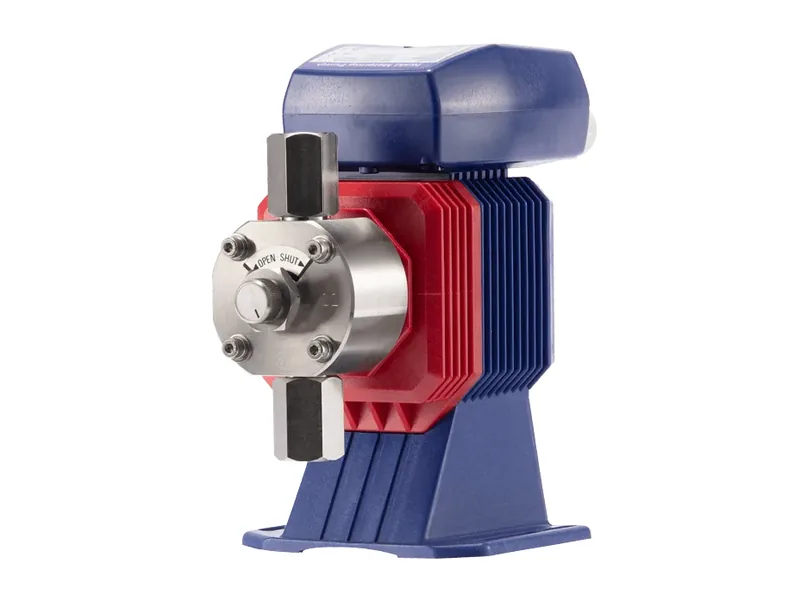
Figure 1: IWAKI EHN-R series electromagnetic metering pump with stainless steel head. Image source: IWAKI official website
- Water flow Q in m³/h.
- Design dose C in mg/L (ppm). One mg/L equals one gram per cubic metre.
- Chemical content of the solution in g/L. For neat product that is density × 1000.
Chemical needed (g/h) = Q × C. Pump flow (L/h) = Q × C ÷ chemical content per litre.
One question to settle with the supplier before any antiscalant dosage calculation: is the dose stated as product (as supplied) or as active ingredient? Most antiscalant doses are quoted as product. If yours is active, divide again by the active fraction, and the answer can change several-fold.
RO example: antiscalant dosage calculation
Assume an RO feed of 10 m³/h, a supplier dose of 3 mg/L as product, and a density of 1.1 kg/L:
- Chemical needed: 10 × 3 = 30 g/h.
- Neat product contains 1,100 g per litre.
- Neat pump flow: 30 ÷ 1,100 ≈ 0.027 L/h, a little over 25 mL per hour.
That is tiny. At such low flow most metering pumps lose accuracy, and a little crystal on a check valve ball is enough to let the dose drift. Small RO systems usually dilute.
Neat or diluted feed in an antiscalant dosage calculation
Assume the same product diluted 1 part to 9 parts water, a tenfold dilution. Chemical content per litre drops to a tenth, so the pump flow rises to 0.27 L/h.
Both options have trade-offs:
- Neat feed: no batching and a stable solution, but low flow makes the pump sensitive to gas and crystals. Best for large systems.
- Diluted feed: higher, easier pump flow, but someone has to batch it. Use RO feed or softened water for dilution, because hard water can precipitate in the tank. Do not store diluted solution for long.
Rule of thumb: if the neat result sits at or below the bottom of the pump's range, dilute. If it lands mid-range, feed neat. Our article on low-flow RO antiscalant dosing covers the hardware side.
Cooling tower antiscalant dosage calculation from makeup flow
Cooling towers are where most mistakes happen. A supplier's figure may mean the concentration to hold in the recirculating water or the dose based on makeup flow. The two differ by the cycles of concentration.
Assume makeup of 50 m³/h, 4 cycles, and a target of 8 mg/L in the circulating water:
- Chemical leaves with blowdown and drift, roughly makeup ÷ cycles, so 12.5 m³/h.
- Feed needed: 12.5 × 8 = 100 g/h, equal to 2 mg/L on makeup.
- Neat pump flow: 100 ÷ 1,100 ≈ 0.091 L/h; diluted tenfold, about 0.91 L/h.
Treat the 8 mg/L system target as a makeup dose and you overfeed several times over. For the chemistry behind tower programs, see cooling tower chemical treatment.
Pacing the result of your antiscalant dosage calculation to flow
Makeup and RO feed flows change. A pump on a fixed rate overdoses at low flow and underdoses at high flow. Fit a contact-head water meter on the makeup line: every set volume sends a pulse, and the pump delivers a set number of strokes per pulse. The antiscalant dosing rate then tracks water flow automatically.
On RO, interlock the pump with the high-pressure pump or feed valve, so chemical does not concentrate in a stagnant line during shutdowns.
Setting stroke and calibrating after the antiscalant dosage calculation
Once you have the target L/h:
- Select a pump where the result falls mid-range, not at the bottom.
- Keep stroke length fairly long and trim with stroke rate; very short strokes are more affected by valves and bubbles.
- Fit a calibration column and time the drawdown at real system back pressure, then convert to L/h and correct.
- Record the settings and recalibrate after any chemical or pump change.
Step-by-step procedures are in our metering pump calibration guide.
Common antiscalant dosage calculation errors
Three slips show up again and again. The first is mixing up m³/h and L/h, which shifts the answer by a factor of a thousand. The second is forgetting density: a product heavier than water contains more than 1,000 g per litre, so ignoring it overfeeds slightly. The third is running the antiscalant dosage calculation once at design flow and never revisiting it after recovery or makeup water changes. Recheck whenever the water source or RO recovery changes.
Pump selection for antiscalant dosage calculation results
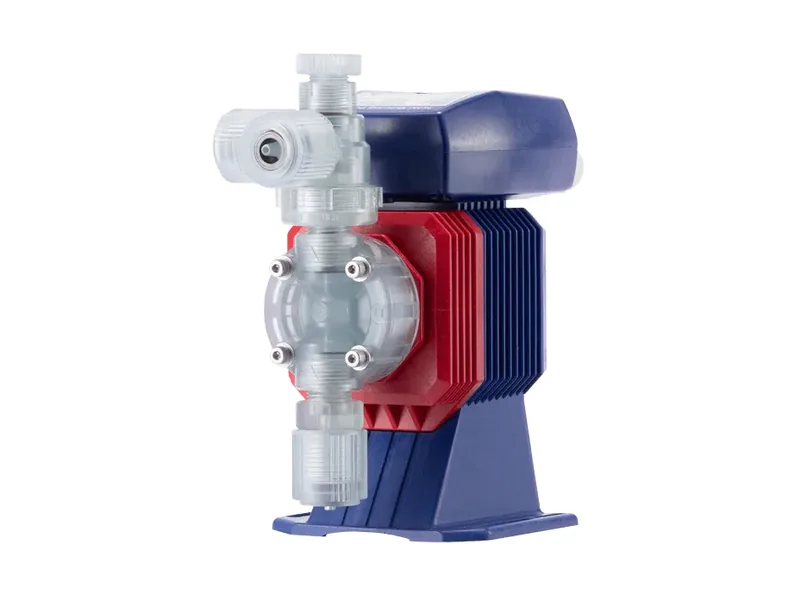
Antiscalant feed is small and often pulse-paced, which suits solenoid pumps. The IWAKI EHN-R series electromagnetic metering pump, for example, is listed by IWAKI at 38 to 450 mL/min, 0.2 to 1.0 MPa and 1 to 360 strokes per minute. Its EXT mode multiplies or divides incoming pulses (1:n or n:1, n = 1 to 999), and a STOP input accepts a level sensor. Head materials include PVC, GFRPP, PVDF and SUS316. See solenoid metering pumps and our IWAKI brand page.
Conclusion
A reliable antiscalant dosage calculation depends on three checks: whether the dose is product or active, whether a cooling tower figure is a system target or a makeup dose, and whether the neat flow sits sensibly in the pump range. Apply water flow × dose ÷ content per litre, dilute when flow is too low, pace from a water meter and verify at real back pressure. Send us flow, cycles and the supplier's dose, and contact our engineers to check the numbers and size the pump.
FAQ
What is a typical antiscalant dose?
There is no universal figure. It depends on water chemistry, recovery and product, so use the supplier's projection.
Can I dilute antiscalant with tap water?
Better to use RO feed or softened water. Hard water can precipitate in the tank.
How long does diluted antiscalant keep?
Not long. Batch a day or two of use and follow the product sheet.
My antiscalant dosage calculation gives less than the pump minimum. Now what?
Dilute more to move the flow mid-range, or choose a smaller pump.
Do I base a tower antiscalant dosage calculation on makeup or blowdown?
Chemical leaves with blowdown and drift, so multiply that flow by the system target. On a makeup basis, divide the target by the cycles.