
Dosing System Isolation Valve: Where to Fit It and How to Choose
A dosing system isolation valve is a manual shut-off valve that stays fully open in service and closes only for maintenance. Its job is to cut off one section of pipe from the tank, the header or the injection point so a technician can open a pump head, replace check valve balls or clean a strainer without chemical pouring out. It does not control flow and it does not stop backflow. Get the type or position wrong and every repair means draining the whole tank, which on an acid or hypochlorite skid is also a safety problem.
Where a dosing system isolation valve belongs
Around each metering pump, isolation valves usually go in four places:
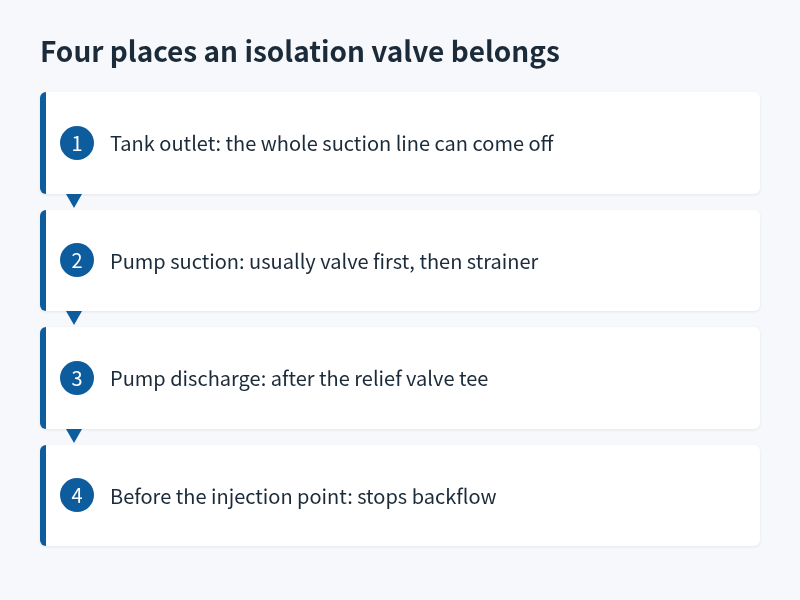
Figure 1: A relief valve goes between the pump and the nearest shut-off valve, with the shut-off downstream of the relief tee.
- Tank outlet, so the whole suction line can be removed.
- Pump suction, typically ahead of the strainer so the screen can be cleaned on its own.
- Pump discharge, after the relief valve tee.
- Before the injection point, so process water cannot flow back when the line is opened.
On a duty/standby skid, each pump needs its own dosing system isolation valve on suction and discharge. That way one pump can be serviced while the other keeps running. Many packaged skid catalogs show the same idea: suction piping with an isolation ball valve, Y strainer and calibration column, and discharge piping with isolation ball valves and a pulsation dampener.
Relief valve first, then the isolation valve
This is the most important rule in dosing system isolation valve layout. The Cheonsei KDV manual states that a relief valve must be installed on the discharge line between the pump and the nearest shut-off valve, and that the discharge shut-off valve sits downstream of the relief valve connection.
The reason is simple. A diaphragm metering pump is a positive displacement pump. If the discharge is closed, pressure keeps rising until the head, the pipe or the diaphragm fails. With the relief valve upstream of the dosing system isolation valve, an operator who closes the wrong valve only sends chemical back to the tank. A discharge isolation valve fitted ahead of the relief valve is the most dangerous mistake on site, so check it at acceptance. The difference between relief and back pressure valves is explained in relief valve vs back pressure valve.
Ball valve or diaphragm valve
Ball valves
Ball valves are the usual dosing system isolation valve. They open and close quickly, have low resistance when open and are compact. PVC, PP, PVDF and stainless steel versions cover most clear chemicals.
Diaphragm valves
Slurries such as lime milk, or chemicals that crystallize in a valve cavity, are better served by diaphragm valves with fewer dead pockets. They are larger and slower to operate.
Valves to avoid
Gate valves rarely seal tightly in small sizes, and globe valves add resistance that hurts suction performance. Neither is a good choice for isolation in dosing lines.
Body and seal materials
Match the body of each dosing system isolation valve to the pipe and the chemical. Seals are where mistakes happen:
- Sodium hypochlorite and strong oxidizers: seats and seals in PTFE or FKM are typical; EPDM depends on concentration.
- Acids: PVC or PVDF bodies, with seals chosen from the chemical resistance chart.
- Caustic and most flocculants: EPDM seals are generally fine.
Use vented ball valves on hypochlorite lines. Hypochlorite releases gas as it decomposes, and gas trapped in a closed ball can build pressure and crack the body. State this clearly on the purchase order, or you may receive a standard ball.
Installing a dosing system isolation valve properly
Point the handle toward the operator side so open and closed are obvious, and tag it "normally open" so nobody closes it on a walk-round. Plastic ball valves should have true union ends so the valve comes out without cutting pipe. On stainless lines, use threaded or flanged ends with a thread sealant rated for the chemical.
Support the pipe on both sides. Plastic bodies are not strong, and pipe weight plus pump pulsation will crack valves and joints over time. A good test for any dosing system isolation valve: you can reach it, see its position, remove it and trust it to seal.
Common field mistakes
A dosing system isolation valve one size smaller than the pipe adds suction resistance and cause priming trouble. Valves hidden behind the skid do not get closed when they should, so plan access during layout. Ball valves that never move tend to seize, so turn them during routine checks. Technicians who close only the discharge valve before opening the head get a flood from the tank side.
Remember too that chemical trapped between the pump and a closed dosing system isolation valve is still under pressure. Bleed it through the vent or bleed valve before breaking a joint; see the dosing pump bleed valve guide.
Conclusion
A dosing system isolation valve is a manual shut-off that separates one section of the line for maintenance. Fit one at the tank outlet, pump suction, pump discharge and injection point. Keep the discharge isolation valve downstream of the relief valve. Use ball valves for clear liquids, diaphragm valves for slurry or crystallizing chemicals, and vented balls for hypochlorite. For backflow protection, read the dosing check valve selection guide, and find valves in dosing accessories and complete chemical dosing skids. Send your chemical, concentration and pipe size and contact our engineers for a valve set.
FAQ
Can an isolation valve replace a check valve?
No. One shuts off, the other stops backflow. A dosing line usually needs both.
Can I throttle flow with the dosing system isolation valve?
It is not recommended. Set flow with stroke or speed; throttling raises discharge pressure and hurts accuracy.
Is a suction isolation valve necessary?
Usually yes when the tank level is above the pump. Without it, opening the head means draining the tank.
Manual or actuated isolation valves?
Manual is typical. Actuated valves make sense only on larger systems that switch standby pumps remotely.
How often should ball valves be checked?
Turn them at each routine inspection so they do not seize. Replace seals or the valve if it leaks or gets stiff.