
Cheonsei Metering Pump Adjustment: Stroke Dial, Speed and Calibration
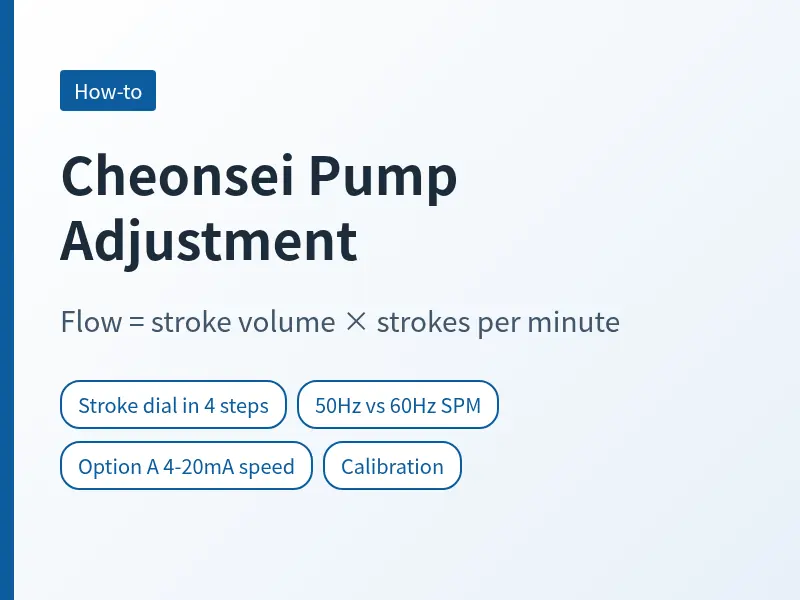
Cheonsei metering pump adjustment comes down to two numbers: how much liquid each stroke pushes (stroke length) and how many strokes the pump makes per minute (SPM). On a standard KEMPION KD pump the SPM is fixed by the motor and worm gear, so the stroke dial is the only thing you set by hand. If you need remote, signal-driven dosing, Cheonsei offers the KD with option A, a brushless DC (BLDC) drive unit that varies speed from a 4-20mA input. This guide is for plant operators and system builders who run KDV or KDH pumps.
How the KD drive sets the flow
The KD is a mechanical diaphragm metering pump. The motor turns a worm and worm wheel, an eccentric cam converts rotation into reciprocating motion of a slider, and the slider shaft moves the diaphragm directly. Check balls in the pump head open and close on each stroke.
Flow is therefore volume per stroke × strokes per minute. The dial changes the eccentric offset of the slider, which changes stroke length. The SPM comes from motor speed and gear ratio. In the manual's spec table, the KDV-21H runs 48 SPM on 50 Hz and 58 SPM on 60 Hz, while the KDV-12H runs 96 and 116 SPM. Same pump, different grid, different maximum capacity. When an imported unit goes onto a 50 Hz supply, size it from the 50 Hz column.
Cheonsei metering pump adjustment with the stroke dial
For Cheonsei metering pump adjustment by hand, the manual's procedure is short:
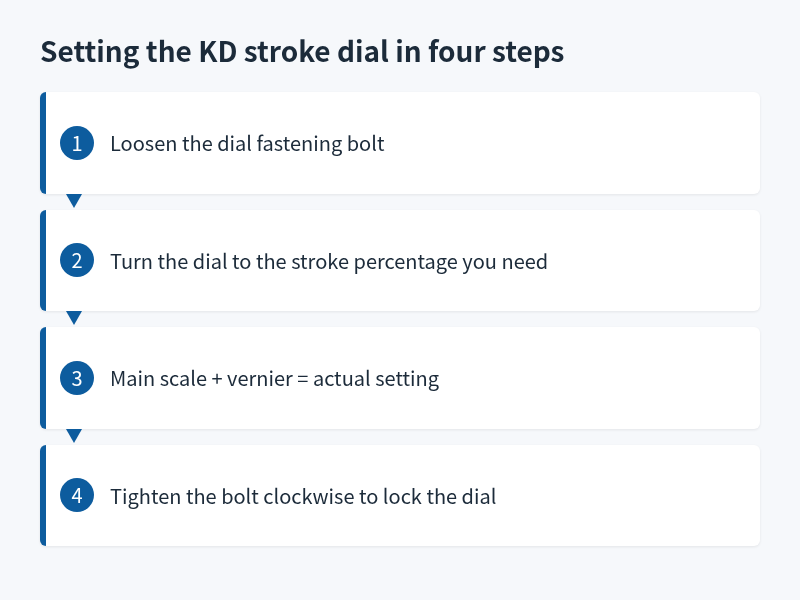
Figure 1: Effective flow adjustment runs from 20% to 100% stroke length; below 20% the reading drifts from actual flow.
- Loosen the dial fastening bolt.
- Turn the dial to the stroke length you need. The scale reads in percent.
- Add the main scale value to the vernier value to get the actual setting.
- Turn the fixing bolt clockwise to lock the dial so vibration cannot shift it.
The English manual asks you to adjust the dial while the pump is running, and that matches what we see in the field: the mechanism turns smoothly under motion. Never force the dial below 0% or past 100%.
Why the bottom 20% is not usable
The spec notes say the effective adjustment range is 20% to 100% of stroke length. Below that, accuracy falls off quickly. Also note that dial turns per percent differ by frame size. The manual draws separate curves for KD-61H/12H, KD-22H to 23H and KD-33L to 54L, so don't copy the number of turns from one model to the next.
Can you change the frequency on a Cheonsei KD?
Not on the standard model. It has a fixed-speed three-phase motor and no setting panel, so for a standard unit, Cheonsei metering pump adjustment means stroke only.
For automatic Cheonsei metering pump adjustment, the model code includes option A, the BLDC M/C unit. According to Cheonsei's literature:
- A 4-20mA input sets motor speed through a built-in microprocessor with PID control, so flow follows the signal proportionally.
- Effective flow range is 5% to 100% of full scale, wider than the 20% floor of stroke-only control.
- An isolated 4-20mA feedback output lets a PLC or SCADA read the pump state directly.
- The motor is rated IP66 and designed for high torque at low speed.
Whether a standard KD can be run from a third-party VFD depends on the motor nameplate and low-speed cooling, so confirm with the manual for that model or your supplier first. Signal wiring is covered in our Cheonsei pump wiring guide.
Calibrate after every Cheonsei metering pump adjustment
In any Cheonsei metering pump adjustment, the dial is only a starting point. Cheonsei states that factory performance curves are measured with clean water at room temperature on test-bench piping, not on your pipework or your chemical.
A calibration column is a graduated clear tube teed into the suction line. Close the tank valve so the pump draws only from the column, then time how far the level drops in one minute. The manual says to wait about one minute after changing the stroke length before measuring. Repeat a few times. If readings are stable and flow is roughly linear with stroke length, the pump is healthy.
We suggest measuring at 30%, 50%, 70% and 100% and posting the curve next to the pump. Next time the process changes, read the setting off the curve. See calibration column and bucket test methods and how to read the main scale and vernier for details.
Start-up order for Cheonsei metering pump adjustment
For the first start, the manual says to set stroke to 0% and run for 30 to 60 minutes while purging air, then run at 100% for another 30 to 60 minutes. Only after that do you raise discharge pressure, checking that motor current stays within rating. In cold weather the current may run high at first because the gear oil is thick; keep running unloaded until it warms.
After a stop of less than a week, you can restart at the existing setting. After a longer stop, return to 0% and run unloaded for a few minutes so the drive is lubricated before you restore the setting.
Flow still wrong after Cheonsei metering pump adjustment?
Two lines in the fault chart relate to adjustment. "Stroke length dial is shifted" means re-set it and lock the bolt. "Excessive feed due to shortage of minimum required differential pressure" means the line is siphoning, which no dial setting will fix; add a back pressure valve. Also, self-priming is about 1 m and that figure is at full stroke, so a pump that won't lift at low stroke may be fine. To check you have the right frame size, read our KD model code guide.
Conclusion
For a standard KD, Cheonsei metering pump adjustment is stroke-only: set the dial, lock it, measure with a calibration column, then fine-tune. For remote control, specify option A so a 4-20mA signal drives motor speed. Send us flow, pressure, chemical and control method and contact our engineers to confirm the right KD configuration, or browse mechanical diaphragm metering pumps.
FAQ
Can Cheonsei metering pump adjustment go down to 10% stroke?
It is not recommended. The rated adjustment range is 20% to 100%, so if you need less, pick a smaller model.
The dial will not turn. What's wrong?
Usually the fixing bolt is still tight. Loosen it first, and if the dial is still stuck, stop and inspect the adjusting shaft rather than forcing it.
Does a 50 Hz pump deliver more on 60 Hz power?
Yes. SPM rises with supply frequency, so both stroke rate and maximum capacity in the 60 Hz column are higher.
Does the option A pump still have a stroke dial?
Yes. Typically you set stroke to a sensible fixed value and let the 4-20mA signal vary speed.
How often should I recalibrate after a Cheonsei metering pump adjustment?
Recalibrate after any change of chemical, piping or stroke setting, and spot-check during routine rounds against the posted curve.