
Cheonsei Pump Error Codes: Alarm Lights and Fault Tables by Model
Cheonsei pump error codes depend on which pump you have. The KD series is a motor-driven mechanical diaphragm pump with no display, so it has no numeric codes; faults are traced with the cause and remedy table in the manual. SP-A solenoid pumps signal alarms with the color of a status LED. Display models such as SP-C offer low-level and signal-error alarms, and the exact characters on screen should be checked against the manual for that model.
People usually search for this when a pump has stopped or a light has changed color and they want an answer fast. This guide to Cheonsei pump error codes collects only the alarms we could find in Cheonsei manuals and on the official website, for operators and maintenance staff. Where no published information exists, we say so rather than guess, and we suggest you ignore unsourced code lists found online.
Cheonsei pump error codes start with the model
The nameplate prefix tells you the family: KD and KH are mechanical diaphragm pumps, SP is the solenoid diaphragm range, and PDS is the pulseless diaphragm series. For what each part of the model number means, see our Cheonsei KD model code guide, and for KDV versus KDH, read Cheonsei KDV vs KDH.
Once the model is clear, jump to the matching section below.
SP-A Cheonsei pump error codes: read the LED
The SP-A front panel has one status LED. According to the official manual:
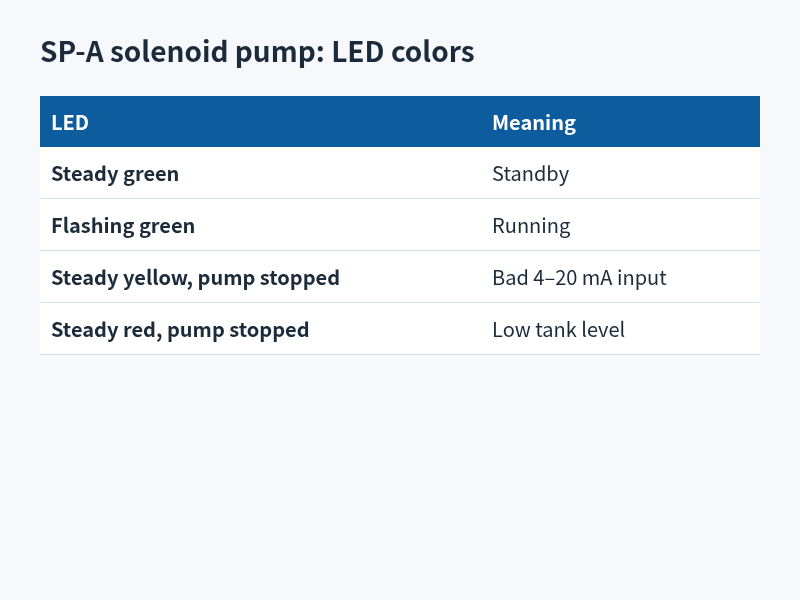
Figure 1: The SP-A signals alarms by LED color; with steady yellow or red the pump stops.
- Steady green: standby.
- Flashing green: running.
- Steady yellow, pump stopped: bad 4–20 mA input signal.
- Steady red, pump stopped: low tank level.
Handling a yellow light
Yellow means the pump is in external control and is not receiving a valid 4–20 mA signal. Check the signal cable for loose or reversed wires, then measure the actual current with a multimeter to see whether the upstream PLC or analyzer is really sending it. Once the signal returns, the pump resumes proportional stroke-rate control.
Handling a red light
Red means the level switch reports low level. Check whether the tank is close to empty and refill it; the pump restarts. If the tank is full and the light is still red, the level switch may be stuck with crystals or its cable may be broken. Replacement switches are in our level switch range.
SP-A pumps with the optional functions also have an alarm output, a dry contact that switches when the pump stops on low level or signal error, so the alarm can reach the control room. Among Cheonsei pump error codes, these LED states are the ones operators meet most often.
SP-C display pumps and Cheonsei pump error codes
The SP-C series has an LCD and a status lamp, and the official website lists low-level alarm and signal-error alarm among its optional functions. The logic matches SP-A: for low level, check the tank and level switch; for a signal error, check the 4–20 mA or pulse input. The exact Cheonsei pump error codes or symbols on the SP-C screen are not published in the material we reviewed, so follow the manual for your model and send a photo to your supplier if in doubt.
KD pumps: no Cheonsei pump error codes, use the fault table
KD pumps have no electronic alarms. Chapter 5 of the Cheonsei manual uses a symptom and cause table instead. Based on that table, the common cases are roughly these:
- Motor does not run: usually electrical, such as a faulty motor, broken or loose wiring, a blown fuse or low voltage.
- Low or no discharge: worn valve seats, debris in the valves, a blocked suction line or strainer, air entering the suction side, a damaged diaphragm, or cavitation from insufficient NPSH.
- Too much discharge: the minimum pressure difference between suction and discharge is not met, so liquid runs through; a back pressure valve fixes this.
- Heavy leakage: a leaking relief valve, a damaged diaphragm or faulty O-rings.
- Hot gearbox: overload or the wrong amount of oil.
A full step-by-step check is in Cheonsei KD not dosing troubleshooting.
Wear parts give their own warning
The manual lists typical replacement intervals of about one year for check balls, ball guides, ball seats, O-rings and the oil seal, and about 4000 hours for the diaphragm, depending on conditions. When flow drops, check how long these parts have run. Refit check valves in the order ball guide on top, ball in the middle, seat at the bottom; the wrong order sends liquid backward and can damage the pump.
PDS pulseless pumps
The PDS manual on the official website also uses a symptom table rather than codes. For low discharge it lists low motor speed, wrong calibration, insufficient suction or discharge pressure, a blocked or leaking suction line, dirty or damaged balls and seats, a worn constant-velocity cam, an aged diaphragm and cavitation. Its BLDC motor control unit has its own fault messages, which the manual refers to a separate controller manual, so follow that document.
Safety before you clear any alarm
Before any repair, isolate power, release discharge pressure and drain the pump head, then wear protective equipment. Every Cheonsei manual repeats this.
Conclusion
Cheonsei pump error codes come down to three rules. KD mechanical pumps have no codes, so use the fault table. On SP-A, yellow means check the 4–20 mA signal and red means check the tank level. SP-C has low-level and signal-error alarms, with on-screen details given in the model manual. See our mechanical diaphragm metering pumps for KD models, and send your nameplate details to contact our engineers for manuals or spare parts.
FAQ
Do KD pumps have Cheonsei pump error codes?
No. KD pumps are motor-driven with no display, so use the fault and remedy table in the manual.
The SP-A shows yellow but the wiring looks fine. What next?
Measure the actual current. Usually the upstream device is not sending a signal or its range is wrong.
Why is the light red when the tank is full?
Typically the level switch is stuck or its cable is open. Clean the switch and check the wiring.
What if my screen shows a symbol not listed among Cheonsei pump error codes?
Follow the manual for that model. Send a photo of the screen and nameplate to your supplier rather than guessing from another brand.
Should I recalibrate after an alarm stop?
Usually not after a level or signal alarm. After replacing a diaphragm or check valve, recalibrate.